MAY 2023
TRIP STATS: A 10-day trip from PERPIGNAN to AVIGNON, via CARCASSONNE, including 8 days of cycling (510km, +1,600m elevation gain of which +1,300m in first 2 days), plus 2 days of walking tours (see Day-0 & Day-3)

It took me a long time to write up this trip owing to the sheer amount of landmarks and sightseeing that pack this route. But here it is at last.
PLANNING & OVERVIEW
All the train used in the trip are TER, since they don’t need reservation (transportation of bicycles is also free, at least for now).
To plan the bike route I used the following websites:
- LA MEDITERRANEE A VELO (EV8), https://www.lamediterraneeavelo.com/
- CANAL DU MIDI (for Le Somail to Sete), https://www.francevelotourisme.com/le-canal-du-midi-a-velo
- https://www.francevelotourisme.com/itineraire/le-canal-des-2-mers-a-velo
- VIA RHONA (EV17, for Sete to Avignon), https://en.viarhona.com
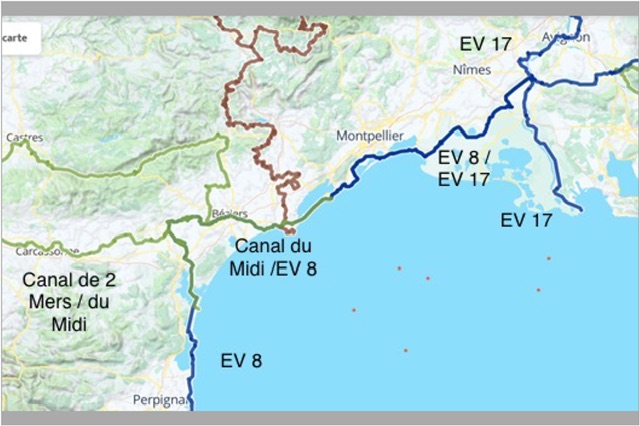
Our tour follows part of La Méditerranée à Vélo cycloroute (part of EV8). This French/European route runs along the entire French southern coast for a total of 850km (in France). It is part of the 7,600km Mediterranean Route (EuroVelo 8, EV8) from Cadiz (Spain) to Athens (Greece) and further on to Cyprus .
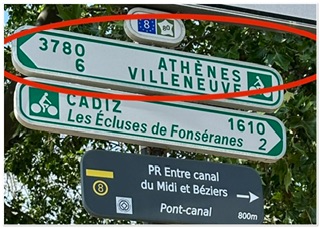

This French section of EV8 also shares some parts of additional French multi-stage routes : the Canal du Midi to the west (which is part of Le Canal des 2 Mers, from the Atlantic Ocean to the Mediterranean Sea); and the ViaRhôna to the east (or EV17, from Switzerland to the Camargue) .
I had cycled the French Eastern EV8 from Antibes to Menton a few years ago during the summer months, which is definitely too hectic, hot and full of tourists for a relaxing trip.
Exploring the Western section in Spring has the advantage of comfortable temperatures and less tourism, appreciating more the natural backdrop and the cultural sites .
During these 8 days of cycling (+2 days of walking tours) we covered most of the coastal Occitania region, starting from the southern city of Perpignan and moving eastwards.
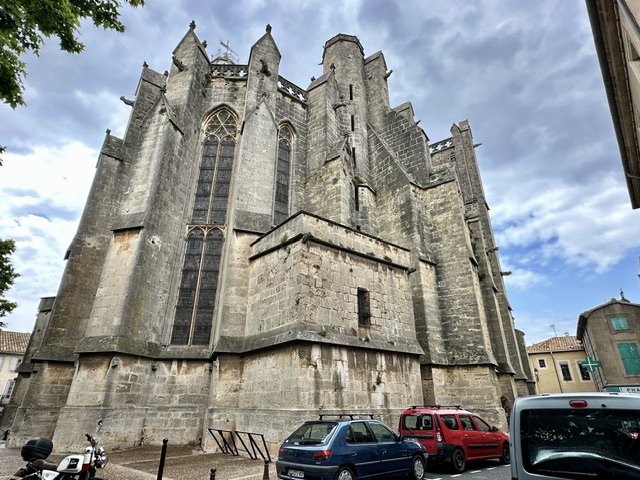
Overall, what struck me the most were the immense cathedrals, which are truly the recurring theme of the tour: it feels like every village/town/city in the 12th-14th century raced to build a bigger and better cathedral than their neighbors.
************************
DAY-0 ( touring Avignon )
The actual start of our bike tour is Perpignan, at the southernmost part of France, not far from Barcelona. This entails boarding several trains with our ebikes and splitting our long train journey into two days, with the obvious stopover in the UNESCO World Heritage Site of Avignon (in the Provence region).
Thus, on this Day-0, we leave Switzerland early in the morning, planning to arrive in mid-afternoon in Avignon to allow for a tour of the Palais de Papes (Popes’ Palace) , which closes at 6pm (reservation needed).
The trains in France are packed during this holiday period, and we discover that the line from Lyon to Avignon requires a bike reservation during these vacation days (free of charge), which we scramble to do via our phones.
Arrived in Avignon, I cannot contain my excitement! The train station is just at the doorsteps of the 4.3km superbly preserved medieval ramparts that surround the old town. The walls, interrupted by fortified towers, were built by the Popes in the 14th century and convey nowadays the ancient importance and splendor of the town.
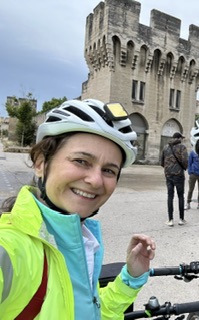

Our little Hotel is right in the historic center, a walking distance from the Popes’ Palace. Although clean, the room/bathroom is really small and the Hotel asks us to store the bikes in the yard of a nearby Hotel, without cover from the imminent rain, paying an extra €5/bike/night (so check out bike storage before booking)!
A little history of this Papal city? Avignon is famous for its short-lived Papal seat from 1309 to 1377, when the Popes fled the political agitation in Rome and found refuge in Avignon. Seven French Popes reigned here and they welcomed Jews and political dissidents. Then, when the last Pope (Gregory XI) returned to Rome and died shortly after, another one decided to continue the Papacy in Avignon and so it started the period of the Great Schism, during which two rival Popes presided, one in Rome and one in Avignon (1378-1417), excommunicating one another.
Interestingly, Avignon continued to be under the Popes until 1791, when it was annexed to France during the French Revolution.
So, let’s go visit this famous Palais des Papes, which I STRONGLY recommend (reservation at https://palais-des-papes.com/en/tarifs/ or https://reservation.avignon-tourisme.com). This is the one stop you cannot miss if passing by Avignon; a couple of hours suffice.
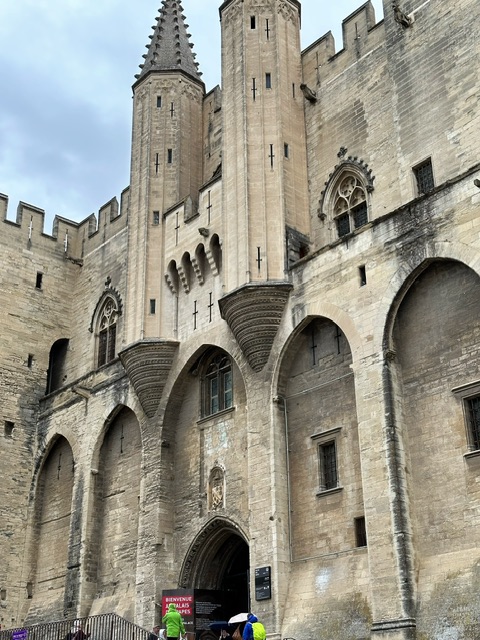
Although the interior of this immense Palace is bare, they provide you with an interactive tablet that, as you move around, it automatically shows how the Palace was furnished, with tags to open and discover more items and read about its history. Tons of children here are enjoying the discoveries via this tablet and reading about the objects and the history around them.

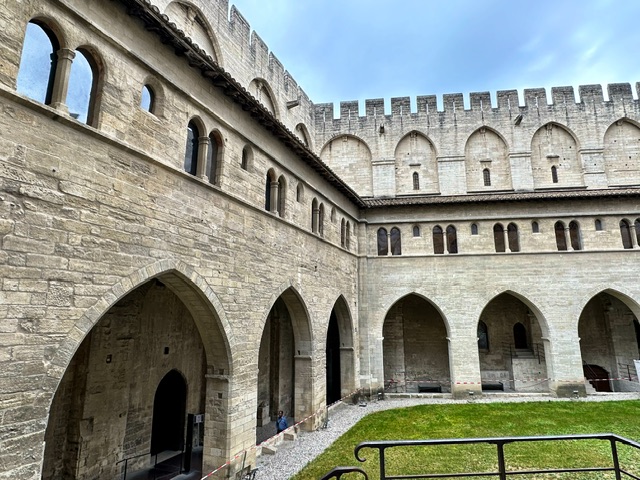
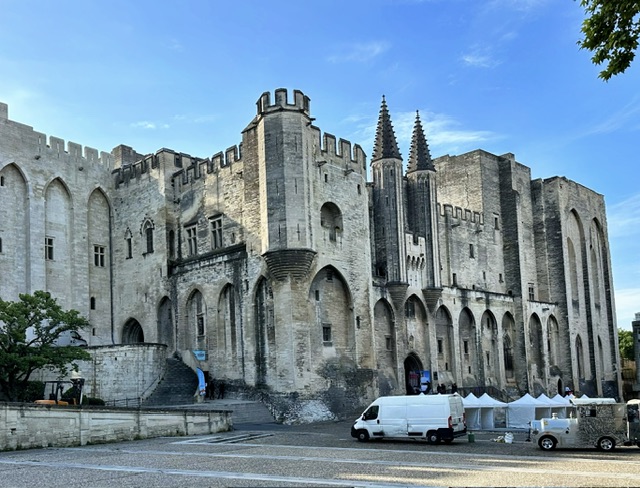
The Palace is a huge 14th century building, considered the largest gothic palace in the world and it is a window into the enormous Papal wealth. At the time of the Popes, the building was immersed in all sort of luxury from textiles to furniture to frescos.
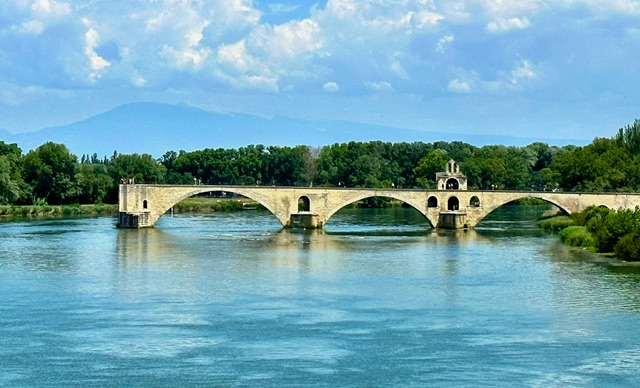
With only a few hours left of daylight, I biked also to the world-famous 12th century bridge “Pont d’Avignon” (now Pont St-Bénézet) , yes the one of the song! Only four piers remain. Interestingly, on its second pier is the Chapel of Saint Nicholas. One can visit the bridge by purchasing a ticket but I don’t think it is worth it.

Incidentally, a much better viewpoint of the “Pont d’Avignon” is from the new bridge across the Rhone along EV17 (we realized this on Day-9 on our return trip – see further below).
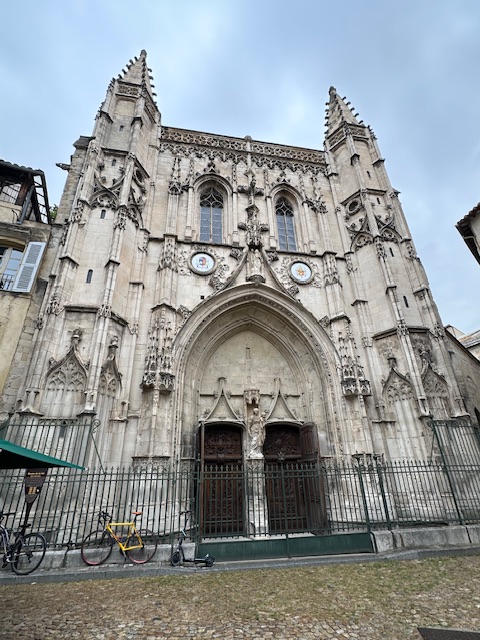
Still, exploring by bike allows me to uncover narrow alleyways leading to other jewels of the old town, like the 14th church of Saint Pierre.

***********************
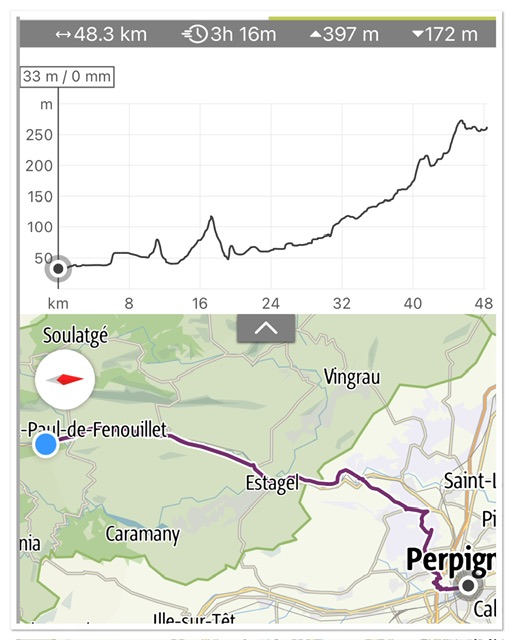
DAY 1 /1st day biking (Perpignan to St Paul de Fenoulliet): 48km, +400m elevation gain
Today we take an early train from Avignon to arrive in Perpignan for lunch. Indeed the afternoon will be spent biking to our first destination at the foot of the Pyrenees.
The train ride along the Southern coast of the French Riviera gives us a glimpse of what we will encounter in our biking trip back up to Avignon.
Arrived in Perpignan, we stop at a café for lunch and then roam the historic town: it is very cute and colorful, with narrow winding alleys and quaint little shops reminding a little of old Nice or Cannes but with brighter colors from the Spanish influence.
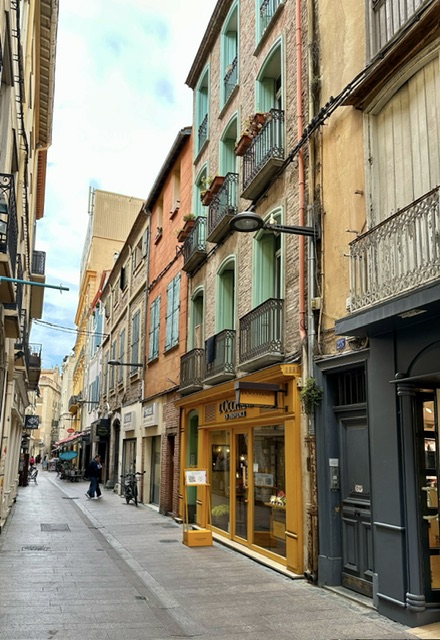
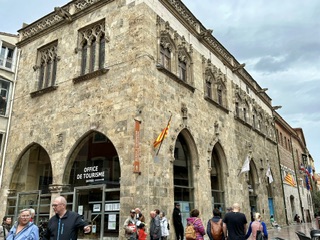
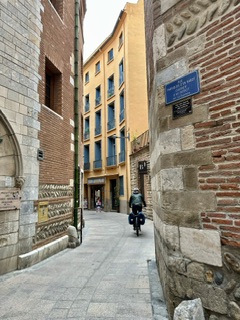
In fact Perpignan has deep roots in the Spanish Catalan culture. Back in the 13th century, it was the capital of the Kingdom of Majorca.
We pass by some landmarks before leaving the town for good:
1) Palais des Rois de Majorque (Palace of the Kings of Mallorca) of the 13th century. It is a large fortified castle with massive walls but from the outside one sees only red-brick walls, like a prison.
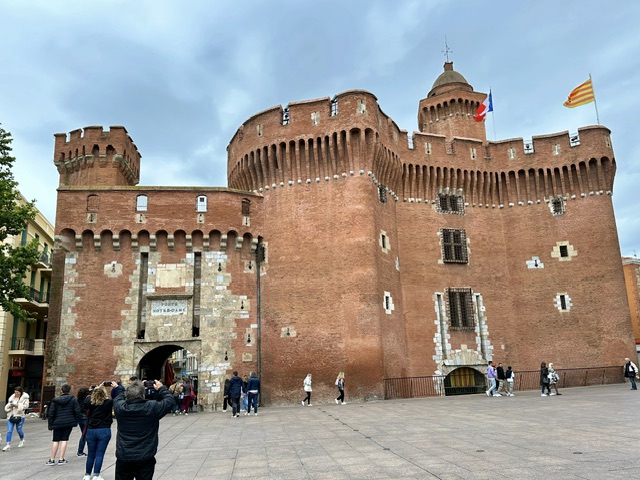
2) Le Castillet: this is a more picturesque building . It is a 14th-century gateway tower turned into museum.
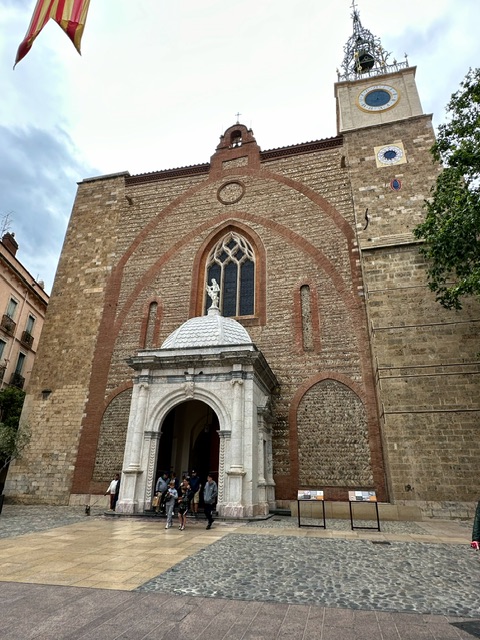
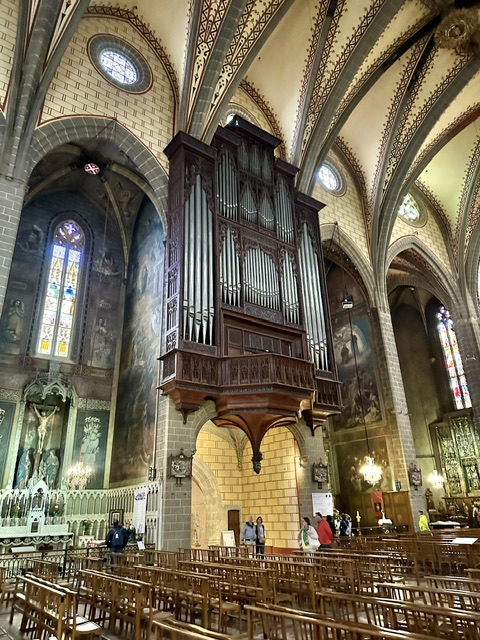
3) Cathédrale St-Jean (15th century) , masterpiece of Catalan Gothic style, with its wrought-iron bell cage and a red brick façade. The inside of the church is incredibly rich: of note is the carved Catalan altar.
Excited to start in earnest our biking trip, we leave the center of Perpignan following my planned route towards the countryside.
And, nooooo……Strike 1: a few kilometers out of Perpignan the rain starts, and it becomes heavier and heavier with strong head-wind gusts as we move inland. The forecast was wrong! We did not expect it until evening….
And ……Strike2: about half-way, 20 km from destination, a flat tire! Not so flat though, probably a minuscule hole that slowly deflates the tire every couple of km. Since it is late afternoon and we NEVER repaired a tire before, we decide to pump it up every km or so making this last section very very very long indeed.
And….. Strike 3: in the last 2 km the battery also runs out ……..
Well we finally arrive to the Hotel but this first day is not the greatest start to our vacation, quite a hellish 49km ride indeed.
At least the route is very well maintained (part of it is on a small country road). They are creating a new veloroute, V81, and so this section is really nice. And the landscape is beautifully wild, in the heart of rough Cathar country (Pays Cathare ), with the backdrop of the Pyrenees grey peaks.
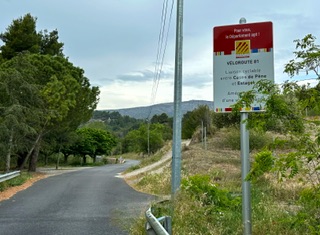

If interested to know a bit more on Cathar country, the website www.payscathare.org has plenty of information. Briefly, the Cathars were radical Christians living in the region around the year 1,000. They were persecuted by the Pope because they were vocal critics of the church corruption. In fact, in 1208, they were hunted by a true crusade against them, the “Albigensian Crusade”. They finally found refuge in various inaccessible castles of the area, the Cathar Fortresses, perched on peaks at the foothills of the Pyrenees.
But in this trip we don’t have time to climb and visit fortresses like Quéribus (728m-high) and Peyrepertuse (800m-high), impressive massive castles built at the top of steep rocky cliffs and dominating the valley below. We will leave it for another time.
Our night destination is Saint Paul de Fenouillet (http://www.st-paul66.com), a little medieval village in the heart of this unspoiled mountain landscape.
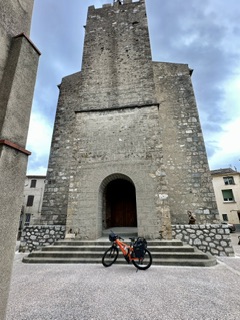

Here, in a small countryside Hotel, YouTube video in hand, we managed our first successful tire repair (Thank God I had brought all the necessary repair items!).
**********************
DAY 2/ /2nd day biking (St Paul de Fenoulliet to Carcassonne): 88km, +700m gain
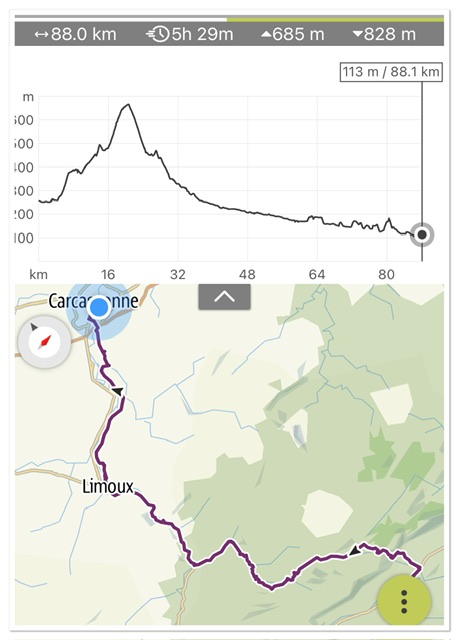
This first full day of biking is the toughest of our trip, purposely scheduled at the beginning when we are still fresh.
After breakfast we head straight towards our first climb through the spectacular Gorges de Galamus.
Even though this initial segment passes through the heart of Cathar country, we are far from any visible fortress . The landscape is quite wild and heavy clouds are hanging over us, predicting more rain.
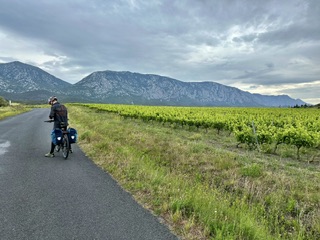
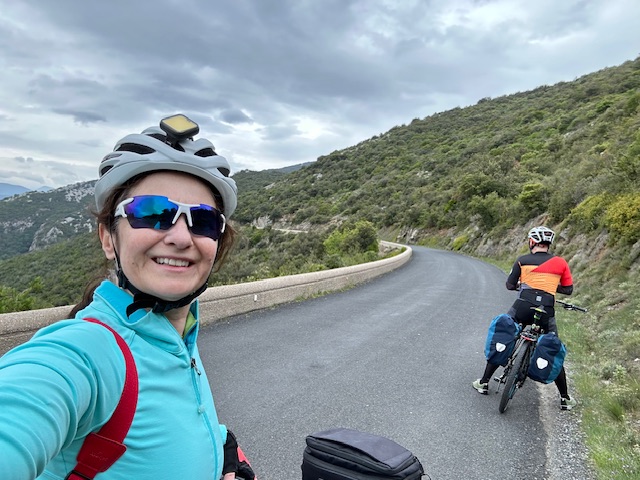
After 10km and 130m elevation we reach what is now known as the Hermitage of St. Antoine de Galamus. It sits at the entrance of the Gorge, hidden on a side of the mountains. To visit the Hermitage, which is signposted by a large parking lot, one has to hike a path in the mountain, leaving bike and luggage behind, and so we skipped it ( https://www.gorgesdegalamus.fr ).
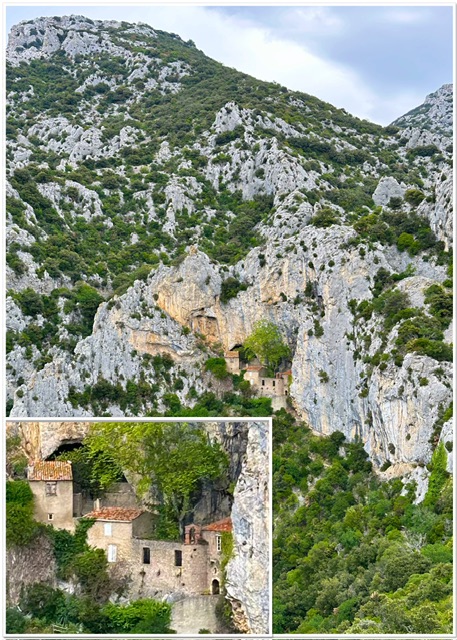
This impervious and unreachable terrain may very well be the reason why, in the 15th century, the Franciscan Friars established here an hermitage in one of the many caves used by hermits since the Middle Ages.
Then, just afterwards, starts the breathtaking 2km narrow winding road up above the Gorge, a road that was dug out in 1890. This road is so narrow that it is impossible for a car to turn around. Luckily buses and caravans are not allowed so the traffic is manageable. At the bottom is a river cutting through the canyon
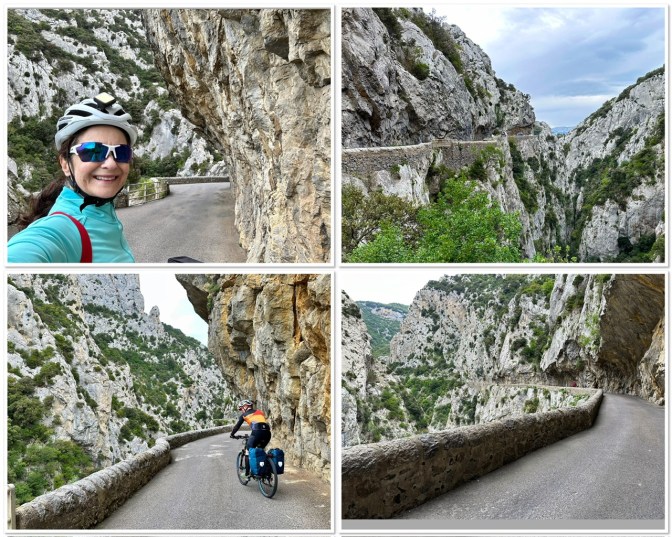
As a side note, the new Veloroute (bikeroute) V81, will connect the Atlantic Ocean to the Gorge.
After the Gorge, the rain starts and we continue up the mountainous landscape for a few km until we find refuge in the tiny village of Cubieres-sur-Cinoble, with a beautiful old church.
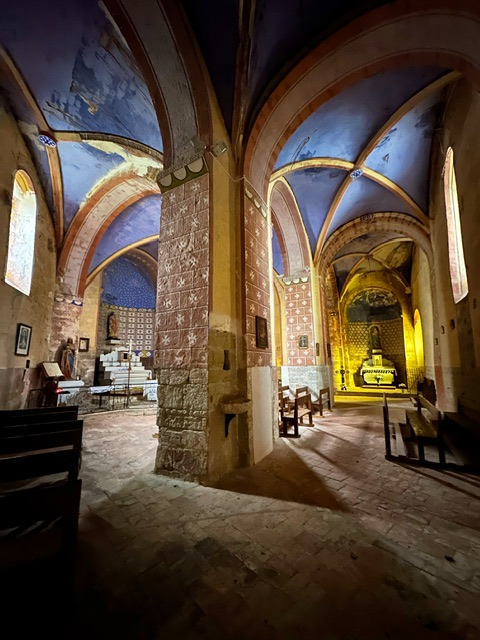
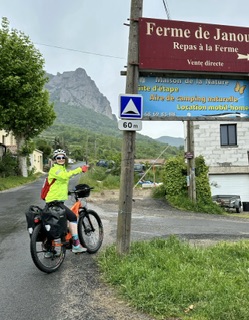
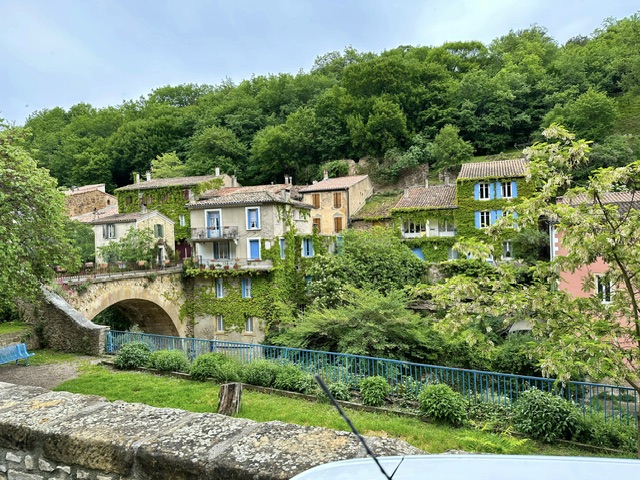
Back on the road, we have another stretch uphill until we start the long descent to Carcassonne. But along the road we cross a few cute villages, first among them Rennes-les-Bains.
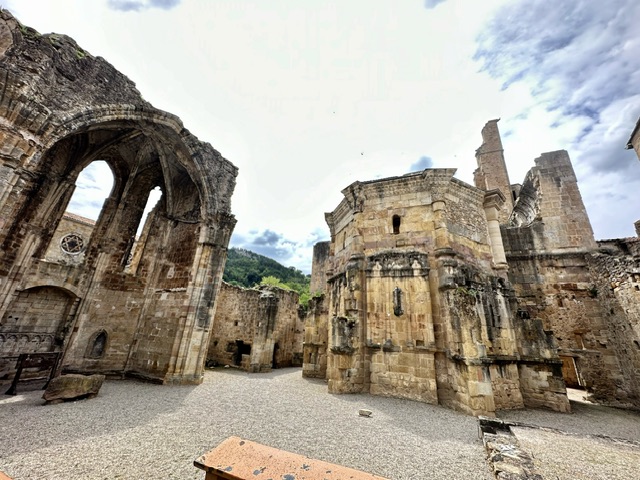
Next, Alet-les-Bains, is a medieval village under the spell of the enormous ruins of its Gothic Cathedral (14th century), one of the largest in the region.


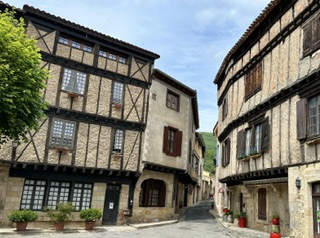
An important hidden gem here is a series of charming medieval alleys, such as Rue Cadène, lined with tudor-style houses with walls of corbelled construction.
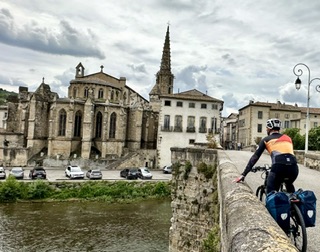
Limoux is a larger and pretty village along the river, but we cross it rapidly.
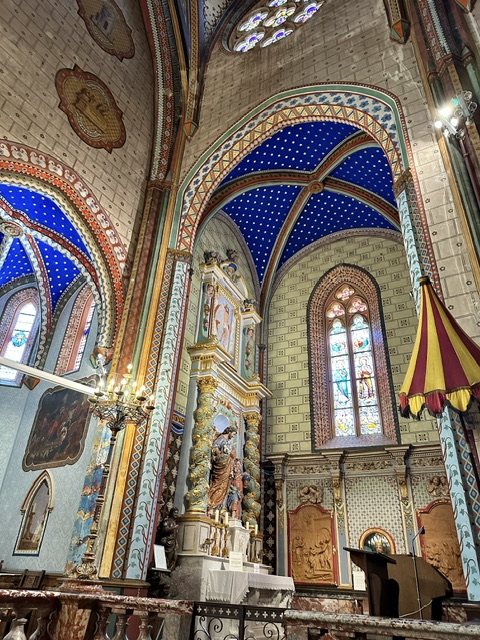
Its main attraction, just outside the town, is the Gothic Basilica of Notre-Dame de Marceille, a pilgrim stop on the way to Santiago de Compostela. This is an incredibly richly decorated church, with bright blue colors. My jaw dropped as I entered the basilica: I have never seen something so colorful especially in a church.


We skipped, for lack of time, the important Abbey of Saint-Hilaire, located between Limoux and Carcassonne. It was initially founded in the 9th century, under the protection of the Carolingian kings.
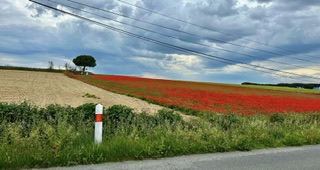
And lastly we arrive at the magical Carcassonne in late afternoon, under the spell of his impressive castle. We are lucky enough that our B&B has a perfect view from the terrace.
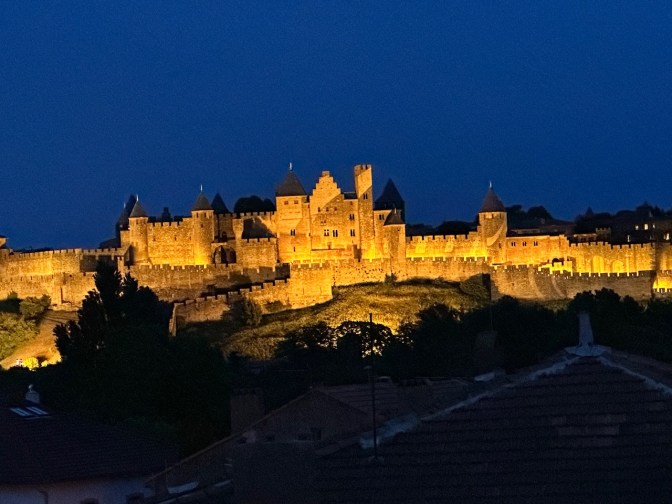
In this long day, filled with beautiful landmarks, we still got rain for a third of the trip, though it did not derail us from an exciting ride.
**********************
DAY 3 /off-day with walking tours in Carcassonne & Narbonne
In the misfortune of bad weather, we were lucky enough to have booked 2 nights in Carcassonne for a day of rest and local touring. With the relentless drizzle of the day, I took the 30 min train to the old town of Narbonne, leaving the tour of the Citadel of Carcassonne for the evening.
NARBONNE (https://www.narbonne.fr): I had initially skipped visiting this city, but what a surprise in beauty and history!
To start, it was the first colony founded by the Romans in Gaul (118 BCE) and it became the capital of Gallia Narbonensis. Indeed, one can still see a part of the Via Domitia below the square of the Archbishops’ Palace.
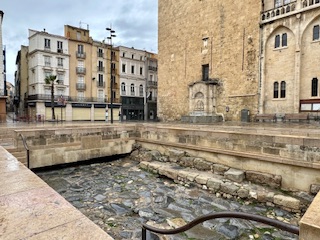
Narbonne actually was built at the crossroads of two major Roman thruways: Via Domitia, connecting Italy to Spain, and Via Aquitania, from the Mediterranean to the Atlantic. In 413, it was conquered by the Visigoths who made it their capital, and then it passed to the Saracens for a brief period in the 8th century. From the 14th century on, the town went into a slow decline, especially after the river Aude changed its course from floods, closing the navigational access to the town. Thus, while in Roman times Narbonne was an important port on the Mediterranean Sea, nowadays it sits a whole 13km inland due to silting. The water “roots” are kept alive by boaters along the Canal du Midi/ Canal de la Robine (see below), making Narbonne a popular stop.
Among the must-see sites are:
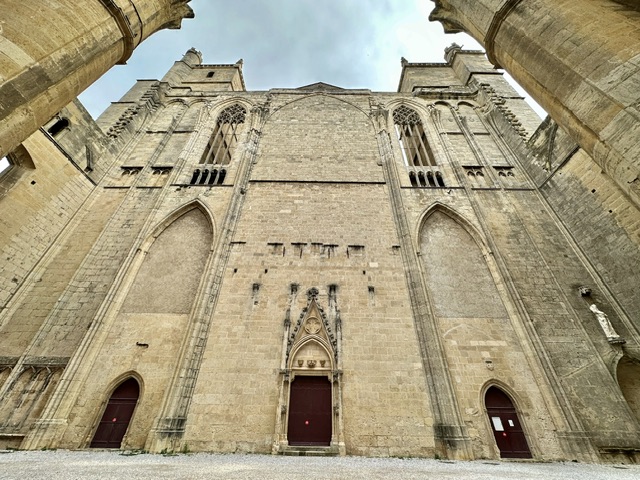
-the gigantic gothic Cathedral of St. Just and St. Pasteur, next to the Archbishops’ Palace, built in the 13th-14th century but left unfinished.

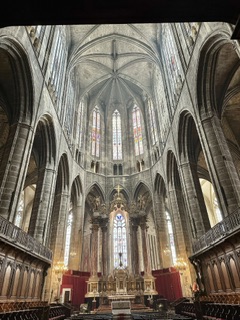
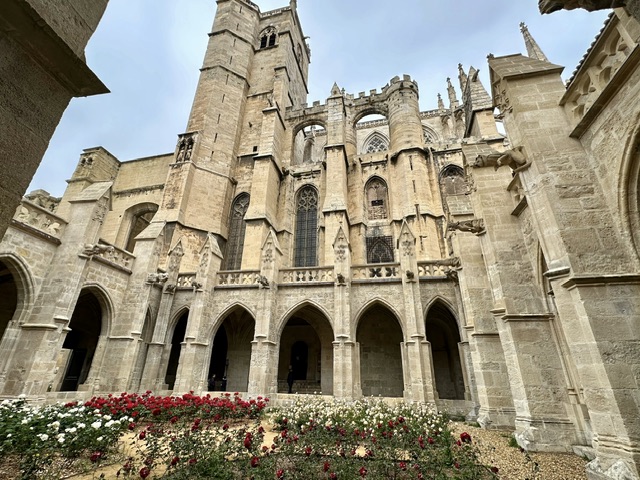
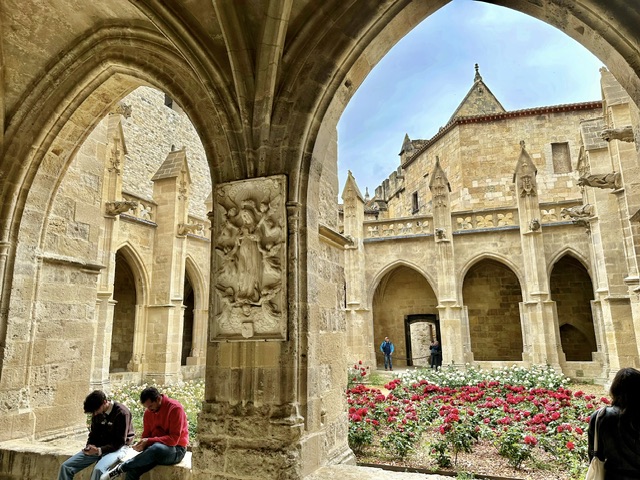
Indeed, the dramatic stop in construction of this imposing building is well visible at the back of the Cathedral. Here, looking up at the incredibly tall sides of the courtyard and feeling dwarfed by them, one wonders what happened to the project ! Maybe it was stopped by the bubonic plague or maybe by a change in fortunes.
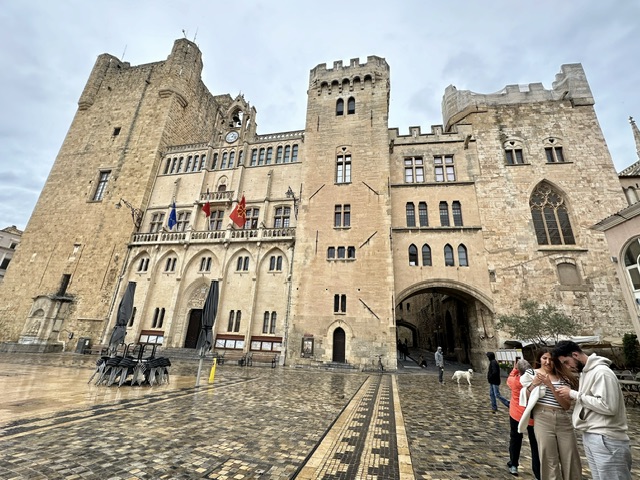
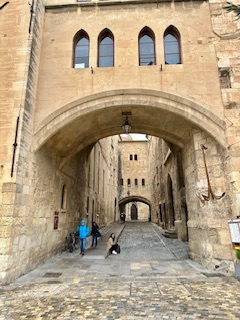
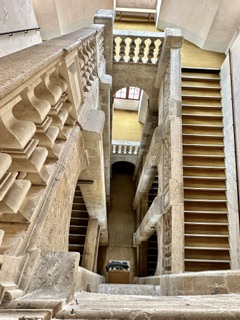
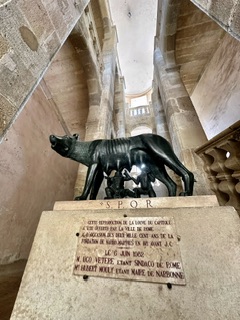
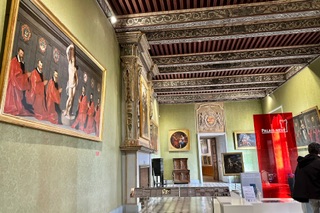
– the Palais des Archevêques (Archbishops’ Palace, built from the 13th to the 19th century), which houses the dungeon, the Archbishop’s chambers with 17th century furniture, and several archaeological museums.
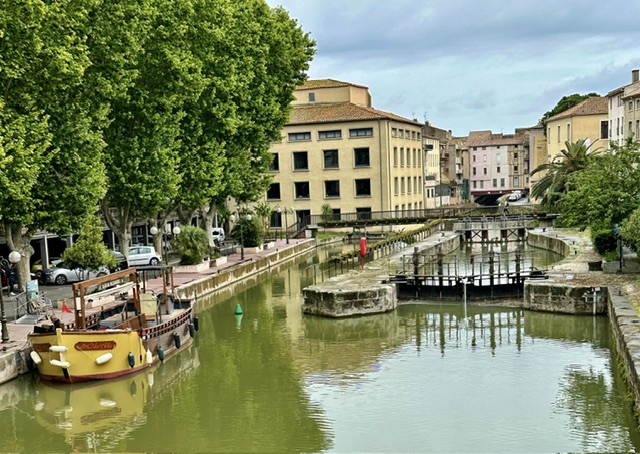
–Canal de la Robine (part of the Canal du Midi). It is incredible to think that this canal was engineered and built in the 16th-17th century as a means to retain the water trade route!
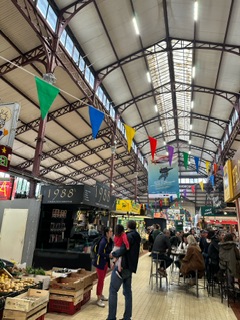
-I would also recommend to go for a bite at the art nouveau-era covered market Les Halles (Mon-Sat).
CARCASSONNE ( https://www.tourisme-carcassonne.fr/en/ )
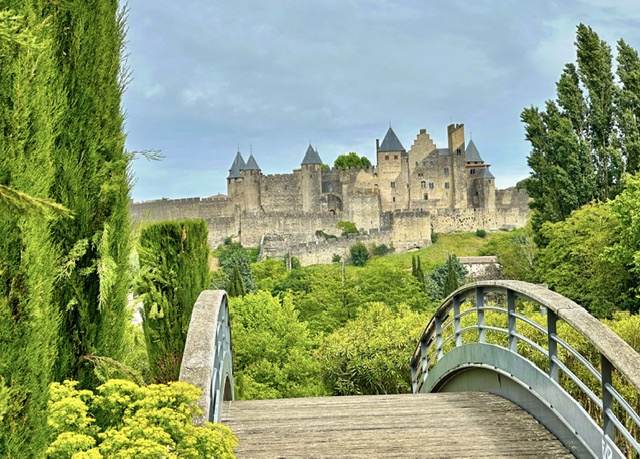
Lit up at night or sun drenched at sunset, the medieval fortified citadel of Carcassonne (La Cité) is a jaw-dropping sight and, rightly so, a UNESCO World Heritage site. It is everything you would imagine a fairy-tale castle should look like, especially when its silhouette is spotted from afar, perched on a hilltop . It is enormous and it contains a real village with still many medieval houses and a large church. It has a Castle within the Castle, 2 city walls (one inside the other, divided by a moat) and 52 towers.
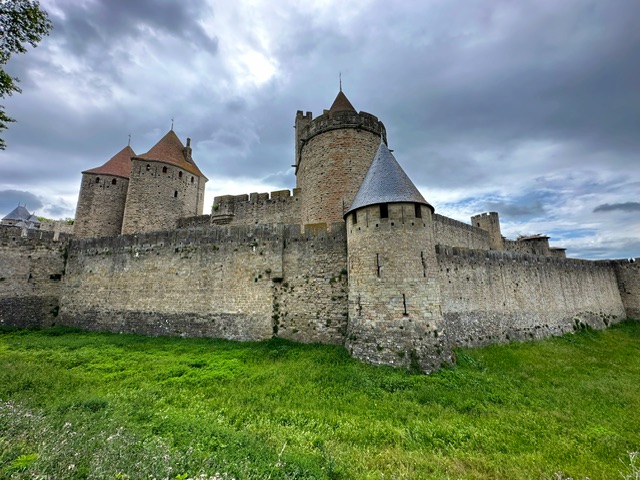
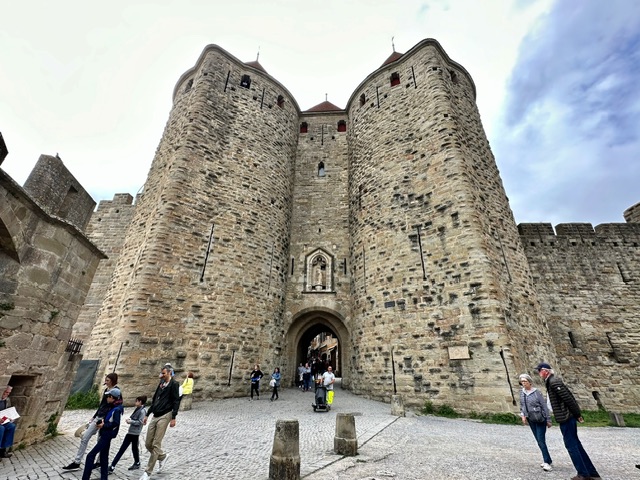


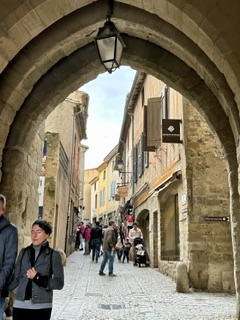
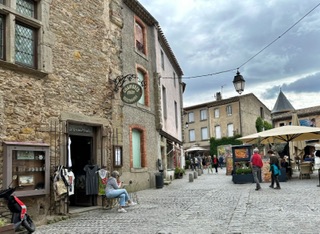
Of course now “La Cité” is vibrant with tourist shops and restaurants, but after 8pm, when the shops close and night descends, it quiets down, and one can perceive for a moment ancient times gone by.
And for more magical moments, one has to see La Citè at sunset, from outside its walls, illuminated in red by the sun, or at night artificially lit up.
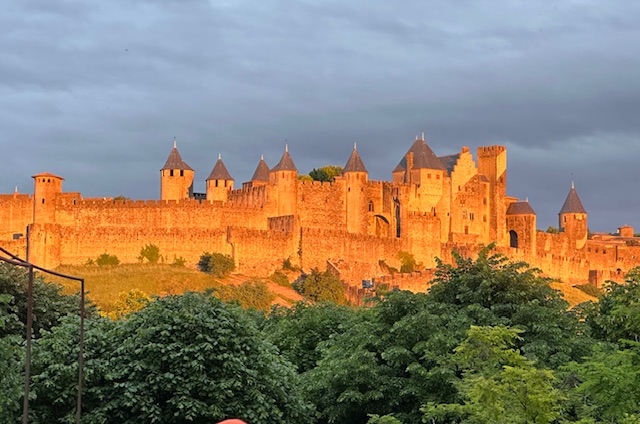
For a bit of history, La Citè (upper Citadel) became a stronghold of Occitan Cathars, flourishing during the Albigensian Crusade (13th century) on the site of Roman fortifications. It then slowly collapsed again during the 15th century. La Bastide (lower town), by contrast, prospered thanks to a flourishing textile industry which lasted for 5 centuries.
La Citè was then saved and remodeled in the Romantic style in the 19th century, becoming the embodiment of the perfect Middle Age fortress.
In Carcassone we also see for the first time the 17th century engineering marvel and UNESCO World Heritage site of Le Canal du Midi (https://www.audetourisme.com/fr/a-voir-a-faire/incontournables/canal-du-midi) . It was created by Pierre-Paul Riquet to connect Toulouse to the Mediterranean Sea and to allow the transport of merchandise on rafts pulled by horses. It is overall 240km long and fitted with 63 locks, and it is one of the oldest channels still in use in Europe. In the 19th century, this was finally linked to the Canal de la Garonne (from Bordeaux to Toulouse), to allow the passage of boats from the Atlantic to the Mediterranean through what is now known as Le Canal de 2 Mers (750km of biking trails, www.canaldes2mersavelo.com ).
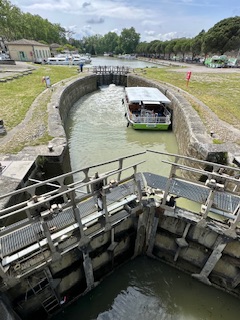
We will be following this Canal in the next couple of days when biking from Le Somail to Sete (end of the canal).
*************************
DAY 4 /3rd day biking: first 18min train ride (Carcassonne to Lezignan-Corbieres), followed by bike (Lézignan-Corbières to Beziers, EV8/ Canal du Midi): 59km, +80m gain.
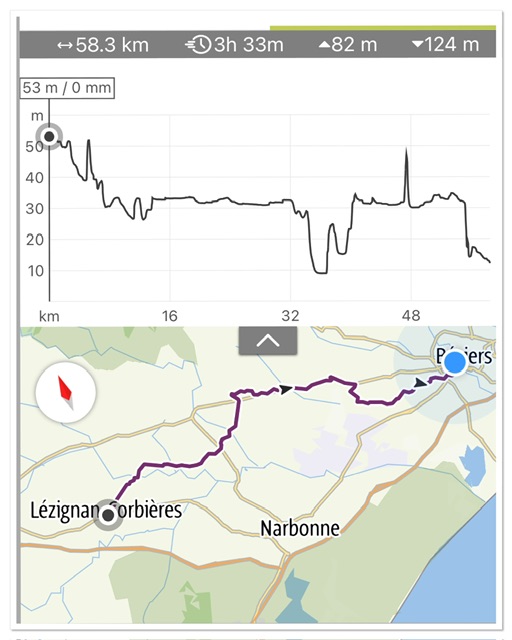
Well, we were supposed to leave from Carcassonne, but because of time constraints we decided to get a lift by train up to Lézignan-Corbières, making it a 59km bike ride instead of 110km. In any case, from what I read, the first 40km from Carcassonne do not have anything special to offer.

Most of this day is along the Canal Du Midi, often on natural but well-kept terrain.

The rain starts coming down as we arrive to the first village, the picturesque 18th century hamlet of Le Somail (meaning “sleep”). Indeed, it was built in the 1700s to provide resting accommodations for travelers and merchants who navigated along the newly completed Canal. A curious architectural finding is the little bridge on the canal (Pont Saint-Marcel) with its peculiar semicircular shape, so typical of the early bridges across the Canal du Midi.

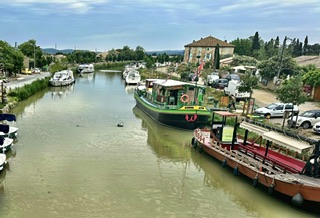
With the rain pouring down, we find refuge under the canopy of a closed café and wait for a good hour that the pounding rain stops.
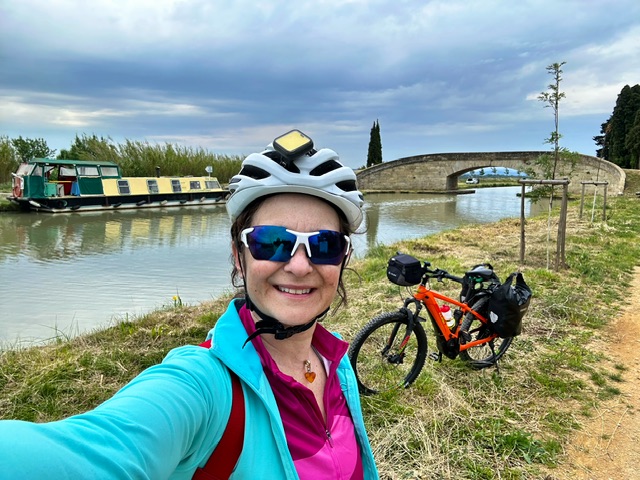
Continuing along the Canal, on a natural path inches from the water, we encounter several boats offering cruises up and down villages.
We then reach the village of Capestang with its 14th century Collégiale Saint-Etienne. We enter this quiet town passing by a welcoming mural and go searching for a restoring coffee. We don’t find much, it looks like a poor small town, so we head for the Collegiale, where an unadorned square hosts a simple café. We sit here for a little to refuel and visit the church.

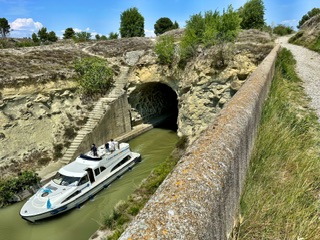
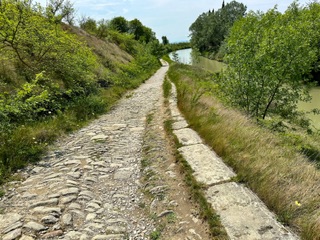
Rejoining the Canal, we discover the “tunnel of Malpas”, excavated in 1679, while a small boat inches out of it. This is Europe’s first navigable tunnel, designed again by the engineer Pierre-Paul Riquet. The bike path next to it is of roughly cut stones and old.
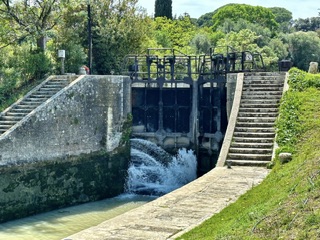
At the end of the day we reach the “9 Locks of Fonserannes”, next to Beziers, part of the Unesco World Heritage site of the Canal du Midi. This is another 17th century engineering masterpiece designed to move up and down boats along the multilevel man-made canal (for a total 21 meter water height difference). Like all the tourists, we stop by the locks and wait for the show of opening and closing of locks, the rush of water through them, and the lifting of boats up by the water.

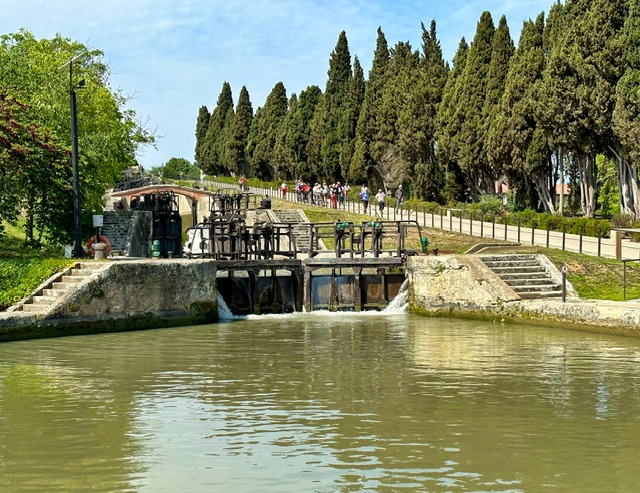
Our B&B is a farmhouse below the perched town of Beziers. Unloaded our bags, washed our bike clothes, we change and bike uphill to dine in the old town.
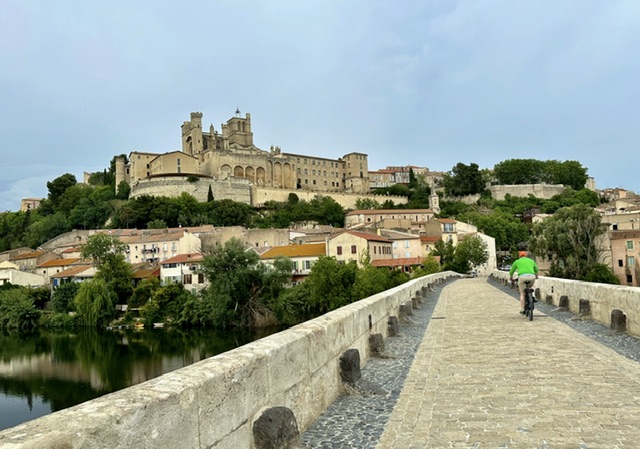
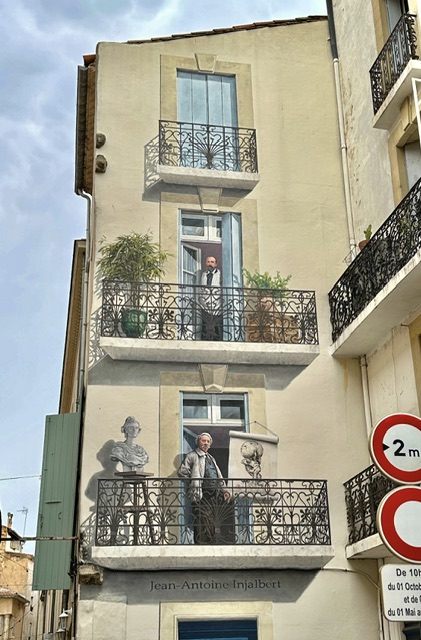
However, we are disappointed. Not much going on up there. We find Beziers also a bit rundown, aside from some nice murals that catch our eyes.

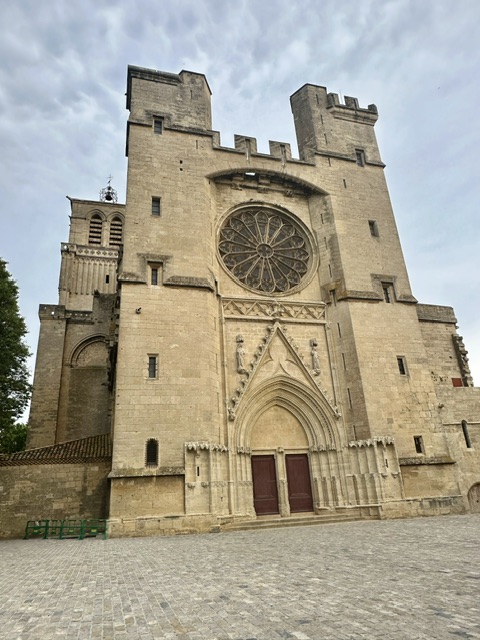
The most significant landmark is certainly the Cathedral Saint-Nazaire. Interestingly, they built an architectural /engineering complex of elevators to bring people from the lower town to the upper town at the entrance of the Cathedral.
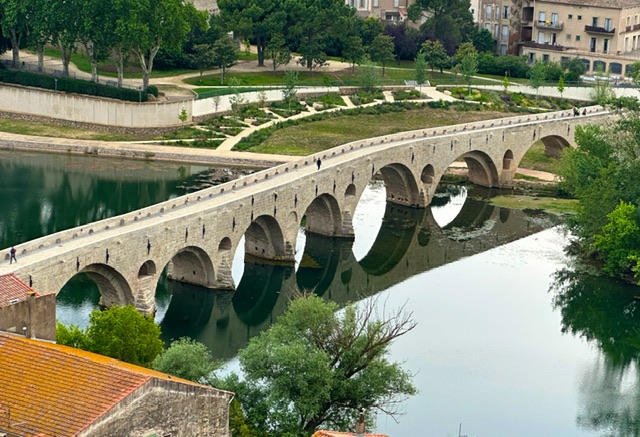
And from the square of the Cathedral there’s a beautiful panorama on the river Orb and all his bridges, including the arched Old Bridge (Vieux Pont) and the Bridge-Canal.
******************************
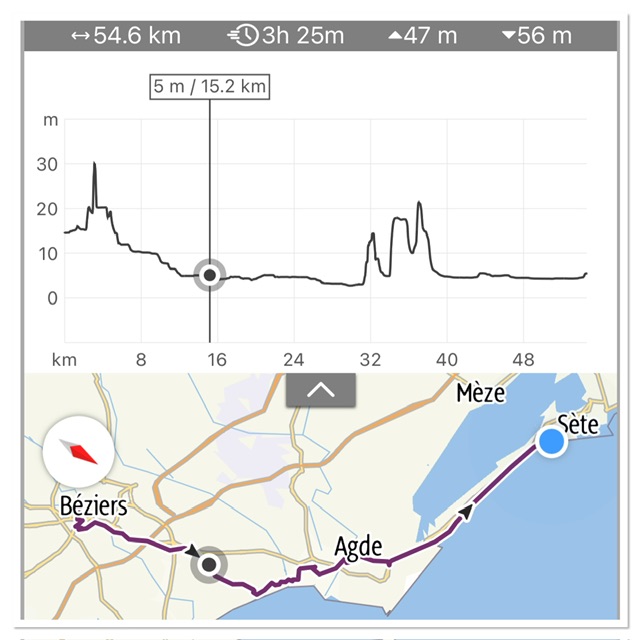
DAY 5 /4th day biking (Beziers to Sete, EV8/ Canal du Midi): 55km, +50m gain
After days of biking in the rain, finally a full day of sun! And from Beziers we head straight to the Mediterranean Sea.
But first we pass once more by the Locks of Fonserannes to rejoin the Véloroute and peek again at the show of locks’ opening and boats’ loading.
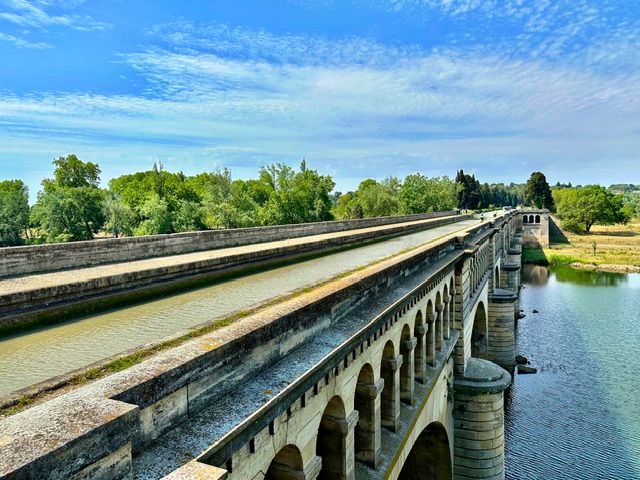
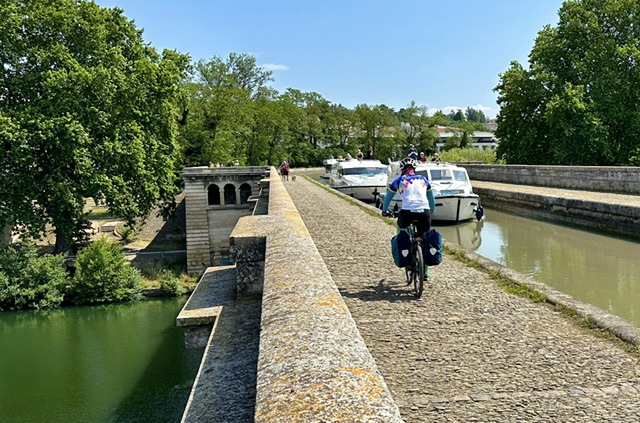
We leave Beziers by crossing an extraordinary Bridge-Canal , built in 1858 to allow boats on the Canal du Midi to continue onto the other side of the river Orb). I’ve never seen such a product of engineering! An absolute marvel. Basically, it is a bridge that, instead of a road, it contains water deep enough for boats to pass through, flanked by sidewalks for pedestrians. Waters above waters! Boats crisscrossing above boats!
The river Orb flows many meters below this arched bridge-canal.
We rejoin the Canal until our next stop in Agde, an old village near the sea.

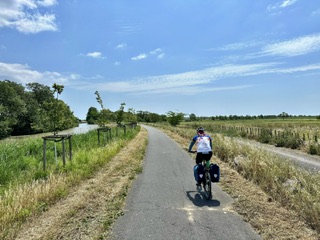
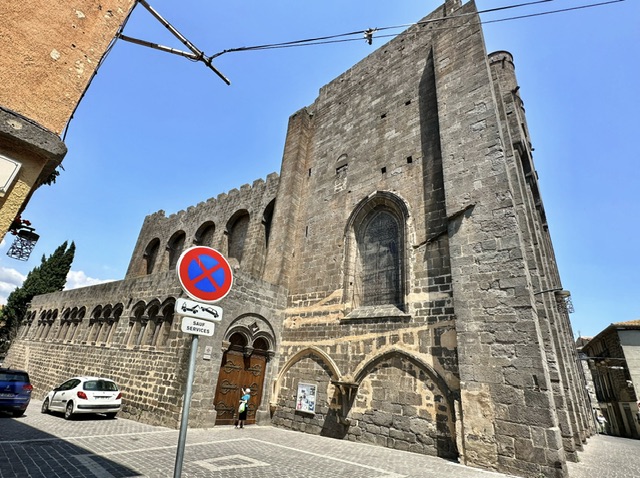
In Agde we found a tasty café restaurant right in the Cathedral square and we stop for a break.
I also wander the old alleys, arriving at a church ( Saint André) built on the same site of an older church that in 506 housed one of the most important ecclesiastical Councils of southern Gaul. Peculiarity of this town, though, are the old buildings constructed with black basalt, including the 12th-century Cathedral of St-Étienne, giving an even more dark & medieval flavor to the area.
Continuing along the route we are enveloped by salty sea breeze and Mediterranean vegetation, until we finally reach a series of large ponds on the coast. The temperature has become hotter by now, even if it is only May. I can’t imagine how hot it may be if cycling this route in full summer!
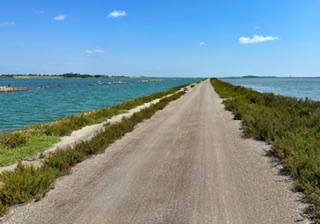
We then enter the thin strip of land that separates the large pond of Thau from the Mediterranean Sea and that will bring us to Sete, at the opposite end of the pond.
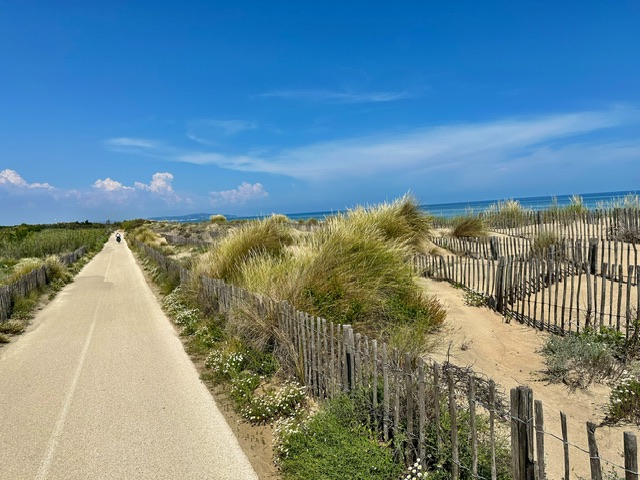
Biking this strip is lovely: we are on a dedicated Voie Verte immersed in low vegetation, and separated by the beach by shrubs and dunes (yeah, actually we cannot see the beach/water even if only meters away).
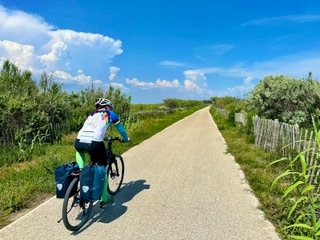
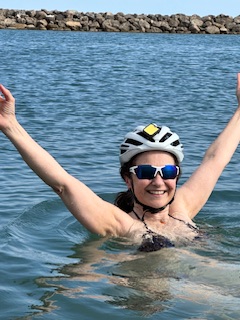
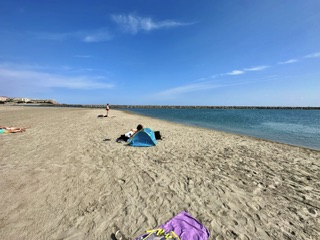
Our Hotel in Sete is right on the beach. And, as soon as we check-in we dive into the water! So refreshing after a long biking day! But, yes, the sea is still very cold this time of the year, probably around 16C.
Sete is France’s largest Mediterranean fishing port and so…..Where are we going to go for dinner? Right. We found one of the many fish-restaurants along the harbor to savor various types of fish specialties.
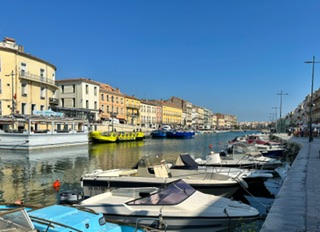
Interestingly, Sete developed quite recently, only in the 17th century, as a terminal harbor of the Canal du Midi, and to replace ancient harbors nearby that became progressively separated from the sea due to silting.
We do not spend much time here for sightseeing since the town does not impress us particularly.
**************************
DAY 6 /5th day biking (Sete to Montpellier, EV17/EV8): 49km, +60m gain

This day is spent biking along the sea, and crossing some interesting villages. We coast the sea for most of the day and we toy with the idea of plunging into the chilly waters, but then we would be all salty and not too comfy for the bike …..
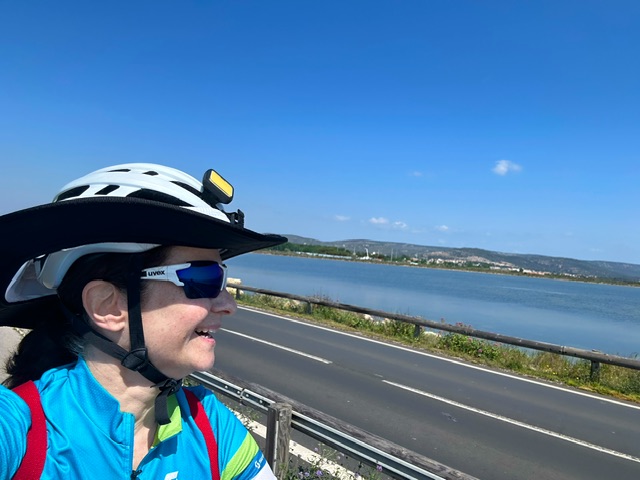
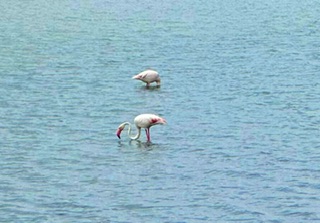
We pass by several natural reserves, between saltwater lagoons and sea, surrounded by the sound of birds and weaves. We spots even several groups of flamingoes fishing in the many ponds.
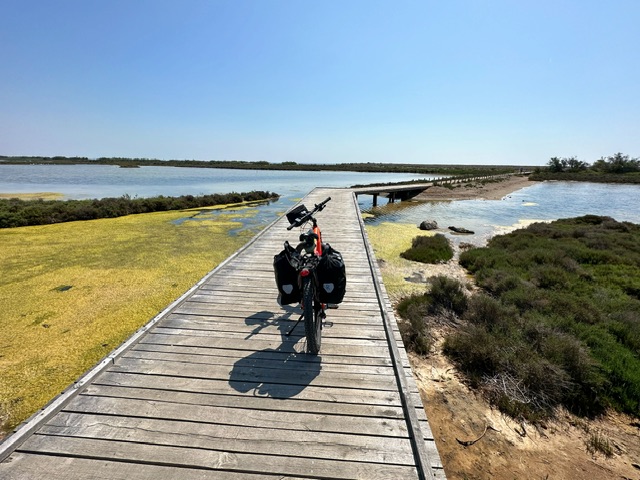
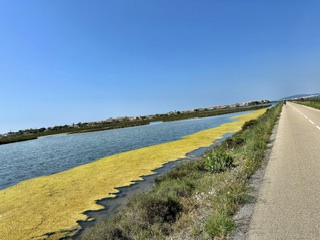
It is a beautiful relaxing ride. The downside of this section (and many others along this Route) is that it is entirely under the sun, with absolutely no shade! But we are all covered up, even with a nice “sombrero” helmet ….
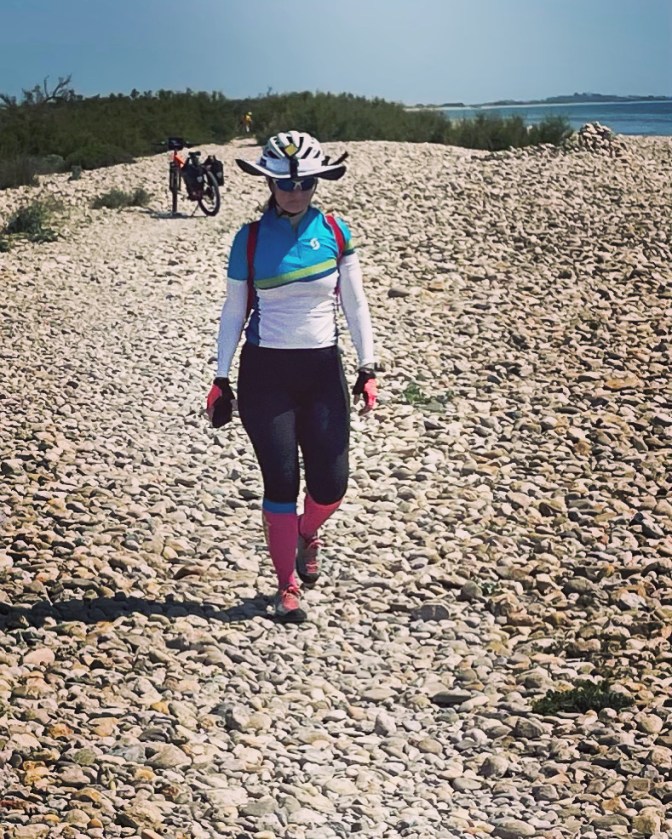
The only cultural stop of the day is the Maguelone Cathedral. This was built on a small peninsula, at the end of the thin strip of land that separates the pond from the sea. The strip can be biked but its access is quite hidden, and I spent a good time on the sandy dunes looking for the path.
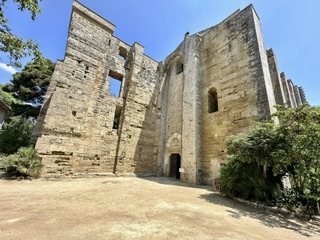
This Cathedral is a mystical jewel, an absolute must-see. It is a massive 11th-century Romanesque building, now quite bare, almost robbed of its ancient glory, though it still serves for religious and secular functions.

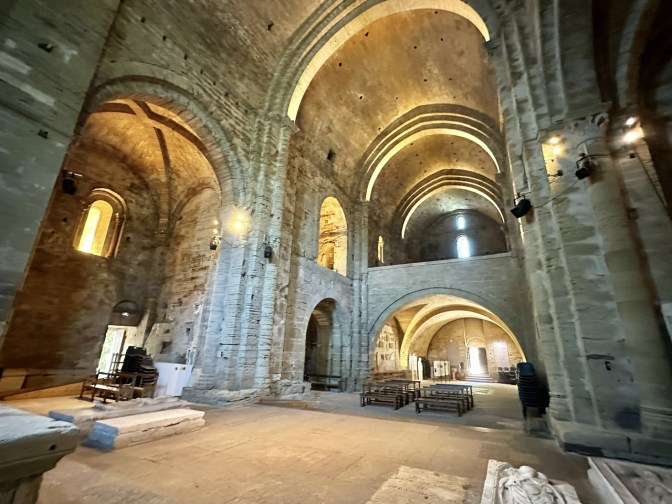
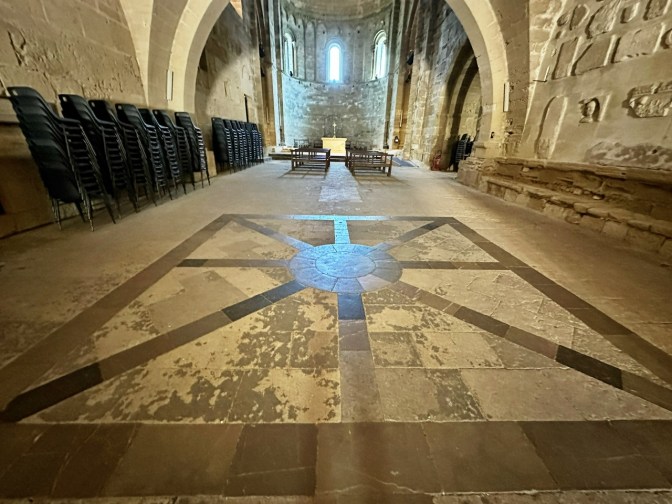

The surrounding park has a romantic mysterious flavor with thick vegetation.
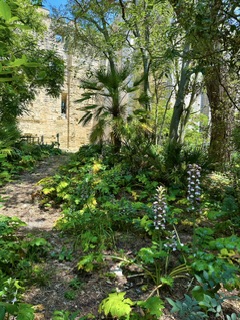
At the site there is also a simple pleasant restaurant with a wonderful view of the sea.
The path continues along the coast until the modern village of Palavas-les-Flots, where we cut inland to reach Montpellier for the night. Our hotel (Mas de Lafeuillade) is a rustic yet elegant old manor house in suburban Montpellier, surrounded by a lush park. The rooms are huge with beautiful original old furnishings and its restaurant is excellent. And this is important because the lodging is really far from downtown and it is …….raining.
**********************
DAY 7/6th day biking (Montpellier-Camargue, EV17/EV8): 98km, +100m gain
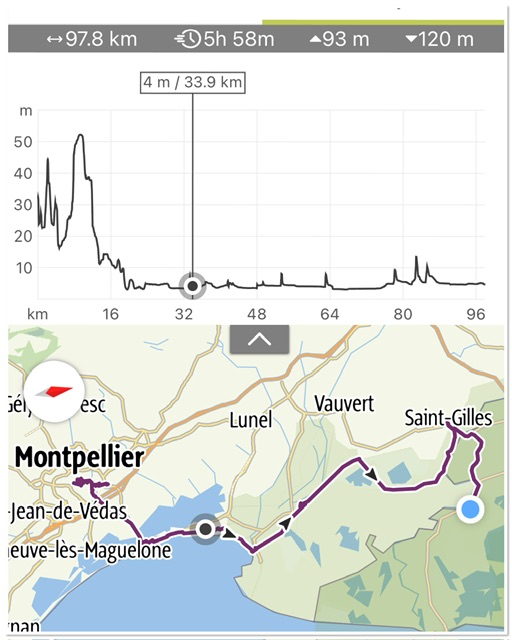
This is the longest biking day of the trip, starting with a detour into MONTPELLIER. The suburban area immediately draws our attention with phenomenal modern architecture and parks all around. It looks like a wonderful city.
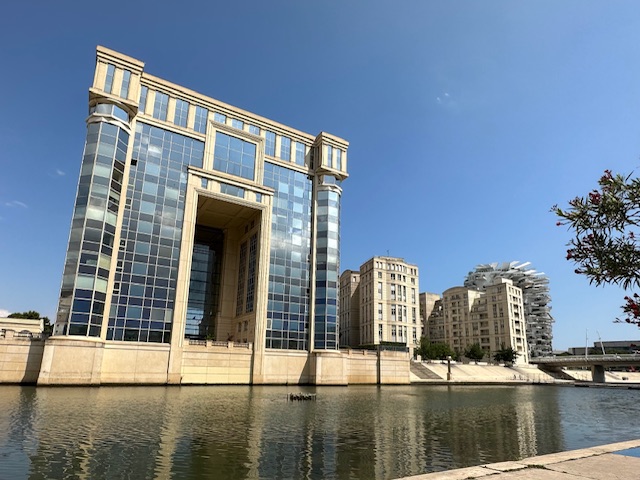
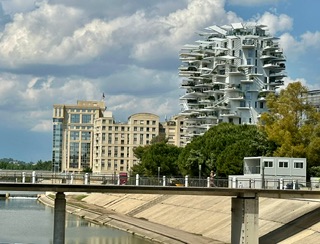
Central Montpellier is full of life, vibrant with a lot of young people, university students (they make up a large portion of the population), plenty of restaurants and small shops all around.
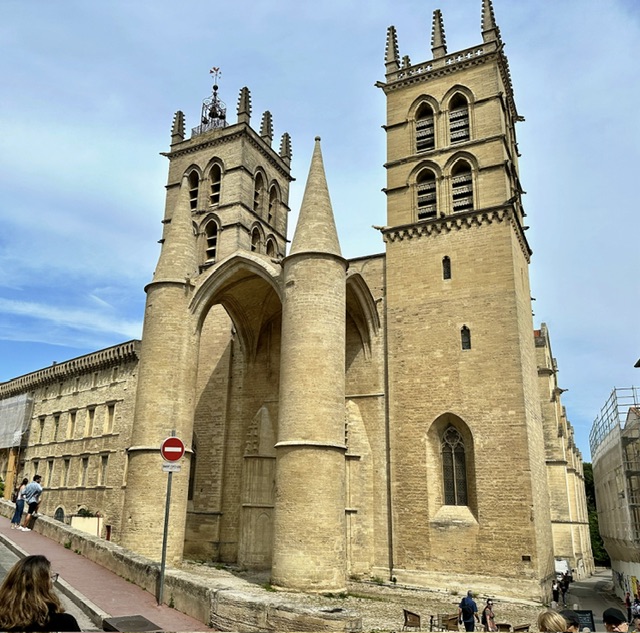
Not to miss is the enormous Cathedral of St-Pierre, squeezed between old buildings and with peculiar conical pillars at the entrance. I never saw a similar architercture.
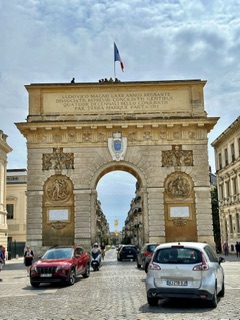
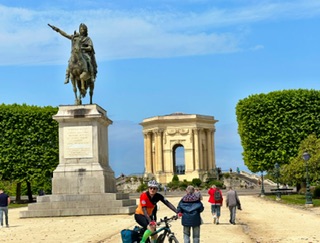
The large central boulevards leads, via the Arc de Triomphe, to a small park overlooking the lower city.
Montpellier is probably one of the few French cities that was not founded in Roman times.
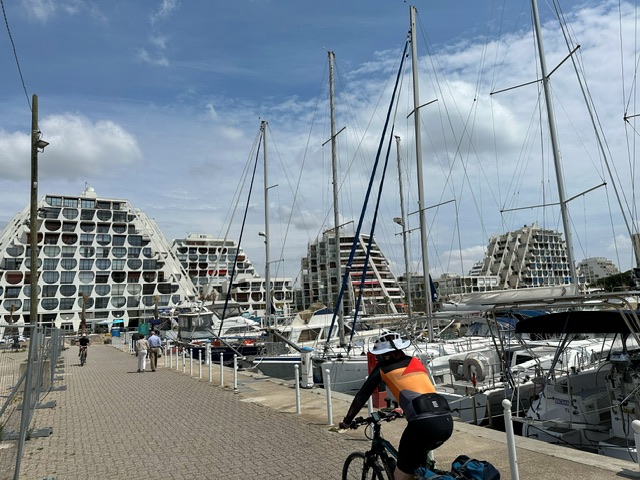
Left Montpellier we rejoin the coast via a quiet Voie Verte until we reach the popular seaside resort of La Grande Motte, with its bizarre pyramidal and triangular buildings.
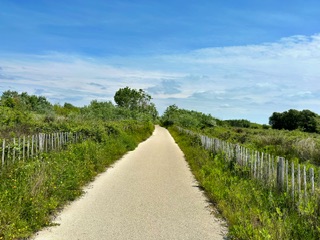
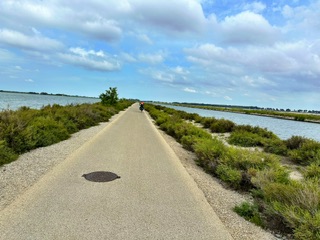
Then, at Le-Grau-Du-Roi we enter another thin strip of land, adapted for bikes, in between a series of ponds.
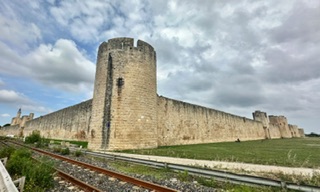
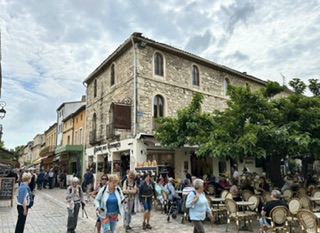
Next is the picturesque medieval citadelle of Aigues-Mortes. As we approach the town, we are struck by the appearance of its very long fortified walls (13th century).
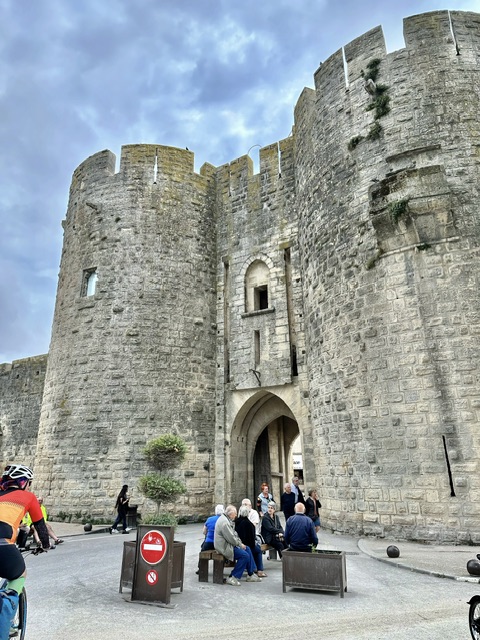
At first we cannot understand where we are, nor which immense city-castle we are facing, since, in my research, this town was not earmarked with a particular landmark. So this was an amazing surprise. But not knowing in advance, means also that I had not scheduled time to stop here. What a pity! We just have time for a peek into the fortified entrance: well the citadelle is now pretty crowded with tourists walking on cobbled alleyways and browsing shops and restaurant, within medieval houses. I’ll make sure we visit again this place in the future.
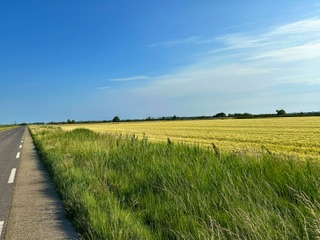
Left Aigues-Mortes, we finally enter the enchanted Camargue, biking through paths along the myriads of canals and marshland crisscrossing this vast idyllic natural park.
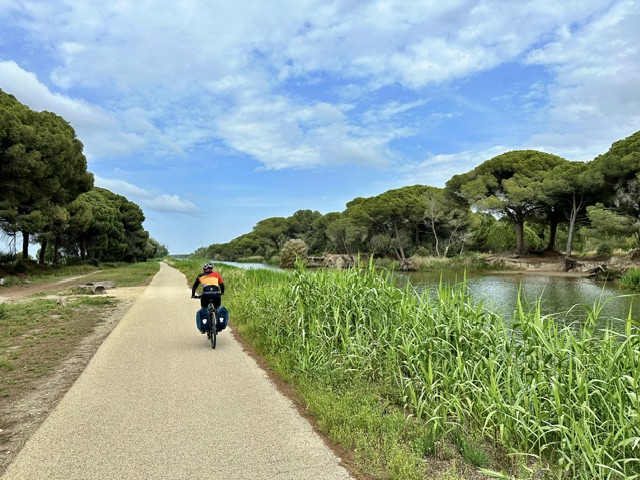


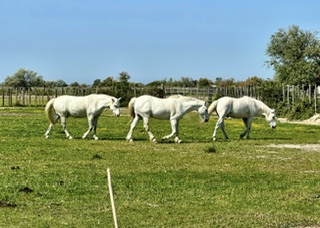
This area is very calm, surrounded only by nature, birds, and the occasional typical white horse of Camargue.
Farm houses and hamlets are scant. The initial path passes at a stone’s throw of Tour Carbonnière, an historic guards’ tower, from which one can have great views of this immense landscape.
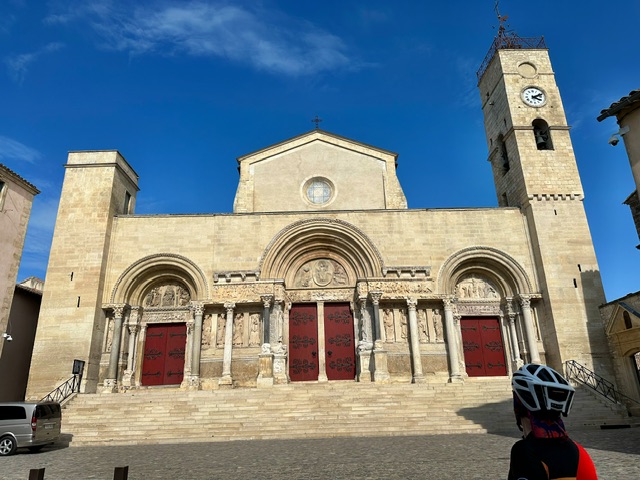
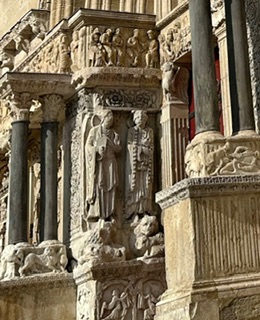
In my research, Saint-Gilles was marked as a village not to miss, situated on a main pilgrimage route to Santiago de Compostela. However, as we enter the village, it does not struck as an awe-inspiring place, except for its 12th-century abbey church with its beautiful ornate façade of miniature sculptures.
It is almost 7pm and we have still about 30min of travel. But the weather is perfect and this allows us to explore the Camargue at dusk, when the light starts setting and animals quiet down.
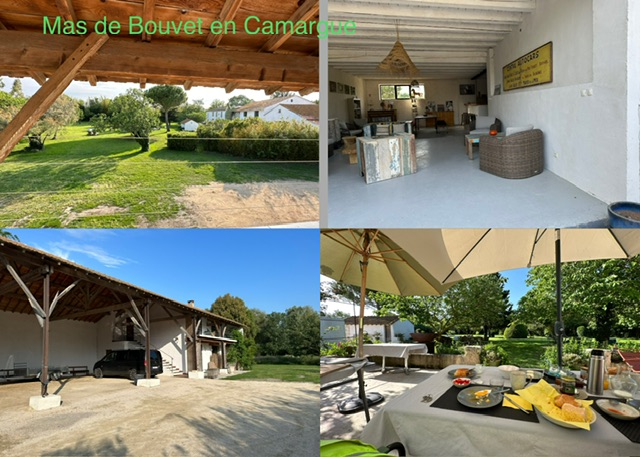
We finally reach our FarmHouse /B&B in Albaron. I want to mention its name, Mas de Bouvet, because this is by far the best lodging of the trip! Enveloped by countryside and marshland, the owner has upgraded an old barn with a couple of comfortable and elegant suites with terraces facing the yard.
But the host does not provide dinner. As luck has it, 1 km down the road is an amazing country restaurant with rustic décor.

We couldn’t have asked for a better end to this fabulous day. Definitely one of my favorite days of this trip.
****************************
DAY 8/7th day biking (Camargue to ARLES to Beaucaire /Tarascon to Meynes, EV17/EV8): 70km, +65m gain
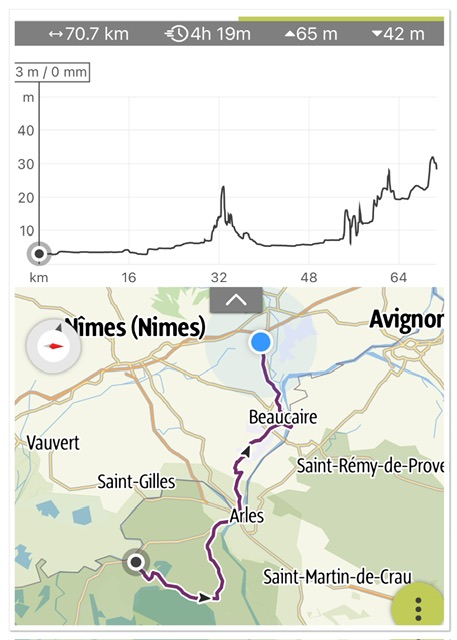
We wake up in the calm and peace of the Camargue marshland. Our first main destination is Arles but we take a large detour southward to explore more of this fantastic and immense natural park.
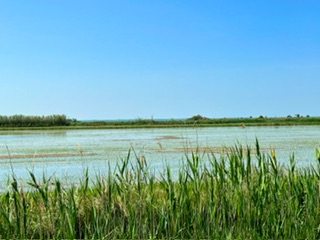
The only drawback is that there are no trees, thus the entire ride is under the sun.
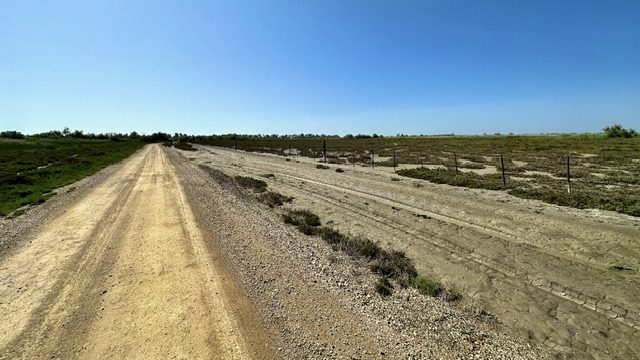
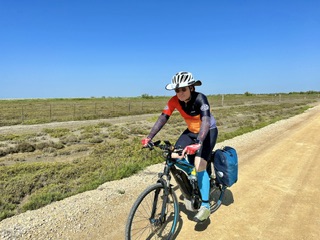
I imagine that this may be difficult to endure if biking in Summer (in addition to clouds of mosquitoes), but in Spring the weather is very nice. We encounter a few farms with white horses and black cows. Quite a contrast!

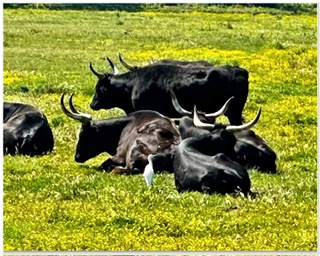
A variety of birds also populate marshes and fields, as indicated by bird-watch posts along the way. Unfortunately we don’t have time to go further south towards the sea and visit the pilgrim’s outpost Stes-Maries-de-la-Mer or the Etang de Vaccarès. Maybe we can bookmark this entire region for another trip, including Aigues-Mortes.
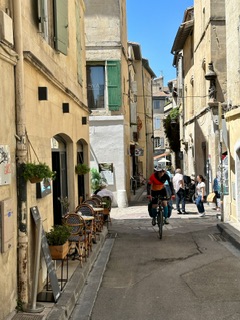
We reach the Roman town of Arles just in time for our lunch break. We wander the narrow alleys of the old quarters until we reach two main landmarks: the Romanesque church of St Trophime and the Roman amphitheater.
Arrived in front of the amphitheater, we remain in awe of this majestic masterpiece, still standing and still used for spectacles.
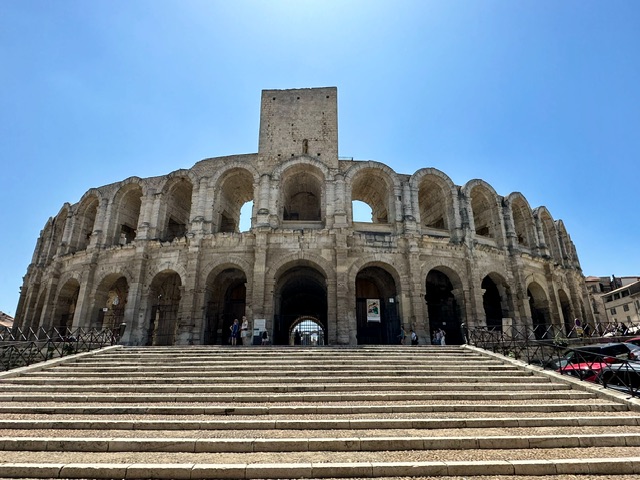
Built in 90 AD, the 20,000-seat oval amphitheater (136m long, 107m wide) was, in Roman times, the site of chariot races and gladiatorial fights where slaves, criminals and wild animals found their death. Interestingly, in the medieval period, it became a protection from invaders, occupied with houses and churches and fortified with four defensive towers. Then, at the beginning of the 19th century, the houses were demolished and the Amphitheater was restored to its original theatrical use.
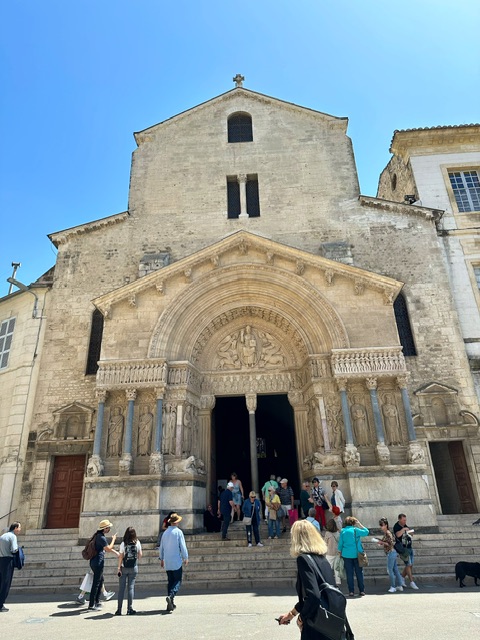
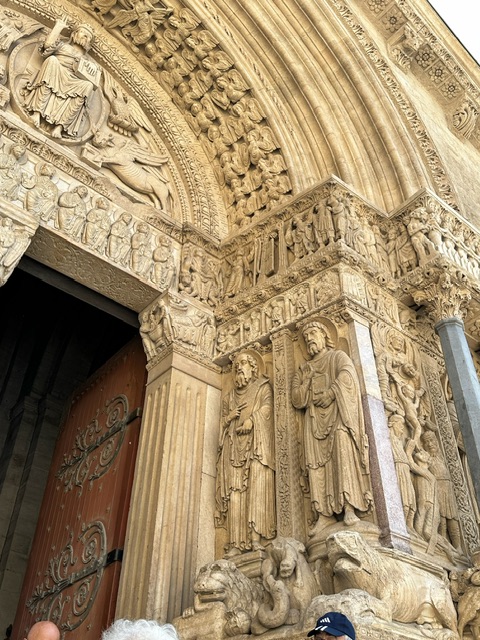
Not to miss is also the church of St Trophime, once a cathedral, built in the 11th-12th centuries . The portal is magnificently decorated with miniature sculptures. Next-door is the 12th-14th century St-Trophime Cloister, suggested as an important visit.
We relax at a bar in a tree-shaded square in the middle of the old town. It has become by now our routine to spend 1-2 hours in these mid-day breaks, reflecting on the day experiences or checking our emails, photos, next destinations, and the news. This time I even take the opportunity to get a good haircut! No time pressure. We only need to arrive in time for dinner at our next B&B.
Back on the bike, we head north following EV17 (Via Rhona).
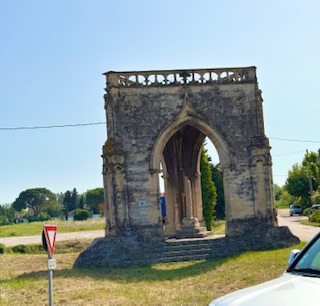
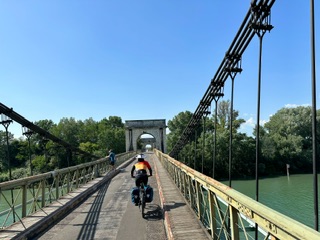
As we reach the twin towns of Beaucaire & Tarascon, separated by the Rhone, we are struck by the unique silhouette of the Tarascon’s castle right on the water.
This impressive and incredibly well preserved Château du Roi René (15th century), built on the banks of the Rhône by the princes of Anjou, has a peculiar geometrical shape. I have never seen the likes of it.

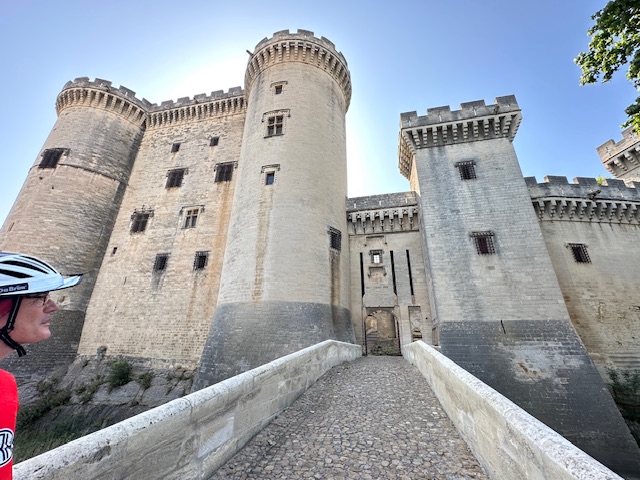
Unfortunately, with the bags on our bikes we do not have the possibility to visit the inside of the castle, but it offers a tour of more than 30 room and an amazing view over the Rhône. I wish I knew this in advance so that we could have planned the night stop in this area. But it is not well advertised. Definitely a landmark to come back to.
We cross back the river and pass through Beaucaire. This is the larger of the twin towns, with its own much larger fortress built to protect the inhabitants during the various medieval invasions.
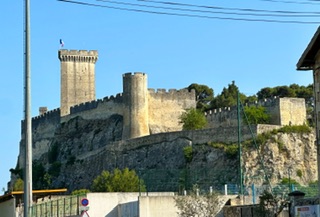
Several other historical sites dot the area, which we have to skip this late in the day (apart from the castle, there’s the underground Abbaye Troglodytique and the river port). Here ends also the water trade route known as “ Canal du Rhône à Sète”, connecting Sète (end of the Canal du Midi) to the Rhone via Saint-Gilles.
We return on the EV17 path, this time using a Voie Verte repurposed old train route, complete with lit up original tunnels.
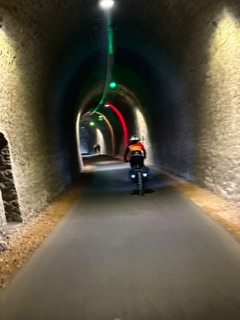
Our B&B for the night is another remodeled farmhouse, Mas De Martinet in Meynes, not far from the EV17 path, in the direction of Pont du Gard. The lodging is surrounded by a green and tranquil setting and the host is very nice, offering to go and pick up pizzas for our dinner.

***********************
DAY 9/8th day biking (Meynes to Grand Pont du Gare to Avignon, EV17): 45km, 65m+

This is our last biking day, “sigh, sigh”, and the easiest and shortest of all in order to catch a train in Avignon and spend the night in Lyon.
After breakfast , we take the same reconverted railway “voie verte” in the direction of Pont Du Gard ( https://www.uzes-pontdugard.com/equipement/la-voie-verte-du-pont-du-gard/ ). This is actually a long dedicated cycling path connecting the 2 medieval towns of Beaucaire and Uzes, and crossing the river Gardon across its famous Pont!

I have to say that Pont du Gard definitely beat my expectations. This is rare since, often, images and references of landmarks you see online are embellished to attract tourists. So I usually keep my expectation a notch lower. But this is not the case here.
This Unesco World Heritage Site ( https://whc.unesco.org/en/list/344/) across the Gard /Gardon river, is not only an astonishing monumental structure, but is also surrounded by an idyllic and peaceful landscape.
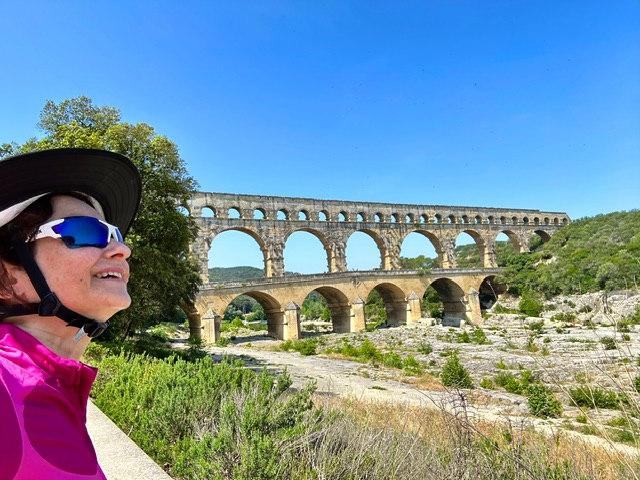
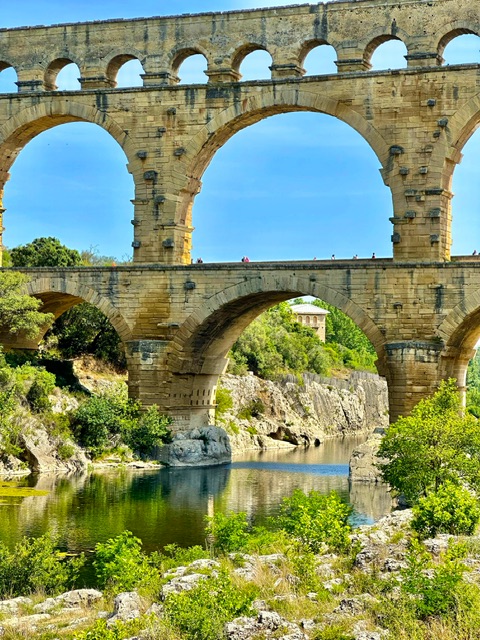
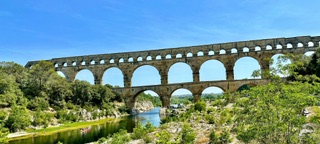
The bridge, or better the aqueduct, built in the 1st century AD, is a masterpiece of Roman engineering and architecture. The three-tiered aqueduct was built to carry up to 40,000 m3 of water/day as part of a 50km-long channel that transferred water from Uzès to Nimes along a minimal incline. In fact, thanks to the aqueduct, Nimes became known in Roman times for its thermal baths, fountains, and water facilities.
The dimensions of this monument are just staggering: 50m high, 275m long and numerous arches along the 3 tiers, which change hues depending on the reflection of the sunlight. It is incredible to think that this huge bridge/aqueduct, so tall and relatively thin, has survived for over 20 centuries. It is indeed the ONLY three-tier Roman bridge in the world still standing!
Starting from the middle ages, attempts have been made to repair parts of the bridge that were losing stones, and to adapt it to allow travel across the bridge. In 1746, Henri Pitot constructed a road bridge attached to the first tier of the ancient bridge (now Pitot Bridge). The bridge is also open to visitors, if you don’t have vertigines… ( https://pontdugard.fr/en ).
Back to our trip, we finally do not cross over the Pitot “extension” bridge , but this could be done as part of another bike trip from Uzes to Nimes. Thus, we peel ourselves off, slowly and unwillingly, from the magical view of the bridge, and we retrace our trail back for several kilometers until we rejoin EV17. This path will lead us directly to Avignon and its train station.
As we approach Avignon, the path switches to a natural terrain on the banks of the Rhone.
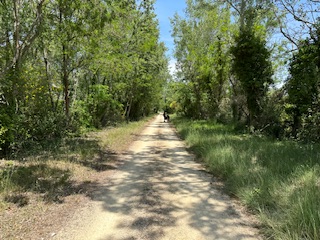
We finally cross the last bridge to enter Avignon, and, yes, second Unesco World Heritage Sites in one day!
From this bridge we have a beautiful panoramic view of the Pont d’Avignon and of the silhouette of the Medieval city; actually, this is the best viewpoint from where to take a nice photo of the famous bridge.
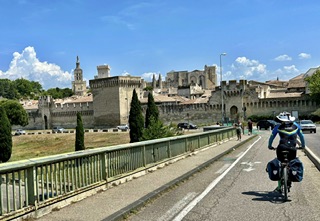
And we are back where we started on Day-0, ready to take the train to Lyon.
We arrive in downtown Lyon right on time for dinner. It is a beautiful evening and we enjoy walking the streets of Vieux Lyon and savoring some good food.
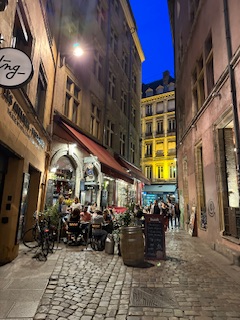
Au Revoir , Vacances, et à Bientôt !
**************************
Final Extra Day of Travel:
This is just a travel day by train from Lyon, about 4-5h, to reach our home in Switzerland, unpack, and get ready for back-to-work!
Goodbye and ….À la prochaine!
************************************
LINKS to Introduction and other MULTI-DAY TOURS:
- BIKING THROUGH SWITZERLAND (with an electric bike)
- NORWAY – Lofoten : Biking above the Arctic Circle
- FRANCE, Via Rhona (Northern part) , 7-day bike tour
- FRANCE- Cycling in the Prealps d’Azur -4 Days (Grasse-Aiglun-Gorges du Cians)
- FRANCE – Cycling the Route des Grandes Alpes (southern half)
- FRANCE – Cycling the Grande Traversèe du Jura

 bikeswitzerlandblog
Thank you very much for this detailed plan and photos, Alessandra. I hope to follow it at some point and am keeping files. Looks wonderful! You’re amazing.
LikeLike
Thank you thank you. Very easy terrain. But very rich in history and landmarks so one needs to know in advance what to visit and what to skip.
LikeLiked by 1 person